All posts by Heather Pringle

Repatriating the Lewis Chessmen from the British Museum

I sometimes think that one of the worst jobs in archaeology today would be  to work as a curator at the British Museum.  Yes,  there is the prestige of researching and mounting massive exhibitions that attract international attention.   But who would want to be on the receiving end of all the ire of foreign governments who want their treasures back,  from Iran demanding the loan of the Cyrus cylinder to Greece pressuring for the return of the Parthenon marbles?  And I sure wouldn’t want Zawi Hawass lecturing me on the return of the Rosetta Stone.

Now a new front has opened up in the diplomatic war to pry loose national treasures from the British Museum showcases–and it’s not at all where you might think it would be.  Last week,  Scottish National Party MP Angus MacNeil called for a debate in the British House of Commons over the repatriation of the very famous Lewis Chessmen discovered in a sandbank on the Isle of  Lewis,  in Scotland’s Outer Hebrides Islands sometime before 1831.

First a very short primer on the Lewis Chessmen,  which are my all time favorite artifacts from Medieval Europe.    A 12th century artist carved the exquisitely beautiful  chess pieces–93 in all–mostly from walrus ivory,  which could well have come from the Greenland colonies,  or possibly even from the Canadian Arctic.  (That’s another story  I’ll save for another day.)  No one knows for certain, however,  where the chessmen were carved,  although some scholars lean towards Trondheim in Norway,  since similar chess pieces were found there.   How these wonderful chessmen–one of the best preserved sets from the medieval world- came to lie in a sand dune near Uig on the Isle of Lewis is unknown.

Shortly after they came to light in 1831, however,  the Hebridean finder decided to sell them.  A private  buyer purchased 11 of the pieces and the rest went to the British Museum, which displays several of these miniature artworks  in one of its galleries.

But now people in the Outer Hebrides want their famous chessmen back.  Indeed, their MP Angus MacNeil is working hard to repatriate them to the Museum nan Eilean in  Stornoway,  the major town of the Outer Hebrides.  And what has provoked this protest?   It appears that the  British Museum has stepped very clumsily on toes and local sensitivities in the Outer Hebrides.  Its curators have been working on a major travelling exhibit of the chesspieces to Scotland and according to a recent online article in The Press and Journal, advertising for the forthcoming exhibit attributes the chesspieces to Norwegian craftsmen,  completely ignoring the possibility that they were carved in the Outer Hebrides.

Is this just a tempest in a teapot?  I don’t think so.   The Lewis chesspieces are objects of of immense pride in the Outer Hebrides,  and someone at the British Museum should have known this.  I am becoming more and more sympathetic all the time to foreign governments and even local museums who want to repatriate their greatest treasures from the vaults and exhibition cases of the British Museum.  It think it’s patronizing in the extreme today to think that only the big national museums in developed countries know how to take care of the world’s most important cultural heritage.

Lights, Camera, Action in Victorian Melbourne

Rose Wild over at the Times Archive Blog has posted an amusing little short film that will never win an Academy Award,  but is worth a quick gander.  At just 24 seconds,  Patineur Grotesque is the oldest known surviving film from Australia–made for a song and a lark I suspect in 1896 on a Melbourne street.  Even then,  the Aussies clearly  loved a laugh. G’day!

The Emperor and the Horse

Last summer while I was researching an article for National Geographic magazine in Ecuador,  I had the remarkable pleasure of staying at the Hacienda Guanchala.  Lying almost exactly on the equator, the Hacienda Guanchala is the oldest colonial hacienda in Ecuador.  Indeed,  some of its buildings date back as early as 1580,  and its shadowy corridors  feel haunted by all the history that has passed through them.

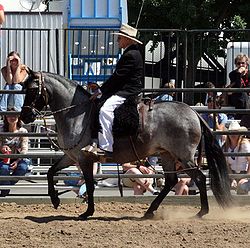
I arrived at the hacienda late in the day,  well after dark,  and after dining there I retreated to my room and lit a fire in the old stone fireplace.   Someone had left several glossy Spanish language magazines there,  and so I began to thumb through them:  they were all devoted exclusively to the Peruvian Paso horse.  I had never heard before of  the Peruvian Paso,  and I was too tired to dig out my Spanish-English dictionary to begin translating the articles.  But I was much struck by the athletic appearance of this horse–with its massive deep chest and its powerful looking haunches.

Yesterday,  I came across a fascinating blog post on the Peruvian Paso.  It turns out that the Francisco Pizarro and his men brought the ancestors of this horse with them when they landed in Tumbes in early 1532 and embarked on their invasion of the Inca Empire.  And they later rode and led these horses by halter through the Andes to a fateful encounter with the new  Inca emperor,  Atahualpa,  in the provincial center of Cajamarca.

Atahualpa had just defeated the forces of his half-brother Huascar in a lengthy civil war,  and he was resting with his wives,  lords and elite bodyguard in the hills outside Cajamarca.   He and his entourage had never before seen a horse.  But in the preceding months,  Inca scouts had sent them a good deal of intelligence about the  Spanish invaders and the large foreign animal they rode.

Pizarro sent one of his bolder captains,  Hernando de Soto,  and several men out to Atahaulpa’s camp to invite him to a meeting in Cajamarca.  To impress on the Inca entourage the power of horses,  de Soto first led a charge on several of Atahualpa’s bodyguards,  sending panic into the crowd.  Then the Spanish captain reined his horse in sharply and trotted over to where Atahualpa sat on a low wooden throne.  He nudged his horse so close to the  divine king that the animal’s exhalations ruffled the braided royal fringe–a mark of imperial office–that hung from Atahualpa’s forehead.  But the emperor betrayed no fear:  he sat impassively as the animal gazed down at him.

Tragically the intelligence that Atahualpa had received about the Spaniards was badly flawed.  His scouts informed him,  for example,  that the Spanish could not ride their horses in the dark.  So Atahaulpa delayed his arrival at  Cajamarca for the meeting until late afternoon the next day.  But the Spanish forces and their horses were ready and waiting,  quickly  slaughtering the emperor’s bodyguard and taking Atahualpa himself a prisoner.

Seldom has one breed of horse witnessed so much tragedy and misery.

My apologies to subscribers who received a garbled version of this blog earlier today.   Something went a little wrong in the blogging software this morning.

Ancient Mariners and Boat-Builders

Now here’s an excavation that I think is worth watching. Archaeologists at Gimhae National Museum in South Korea will return next week to the site of Bibong-ri, along the country’s southern coast,  to expand their excavations.   Some five to six years ago, archaeologists  working at the  shell-midden site made a stunning discovery:  the waterlogged hull of an ancient wooden boat.    Subsequent radiocarbon dating revealed that the wooden vessel was 7700 years old–the earliest known boat to date.

At first glance,  this might not seem particularly exciting.  Archaeologists now know that human beings became seafarers at least 50,000 years ago,  when modern humans crossed nearly a dozen straits to reach Australia from Southeast Asia.  And the new archaeological evidence of stone hand-axes from Crete suggests that ancient humans may have been island-hopping  in the Mediterranean 130,000 years ago or earlier.

What kind of watercraft did these early seafarers favor?  We simply don’t know, although some archaeologists speculate that the early mariners from Southeast Asia voyaged to Australia on rafts made from giant bamboo.  But the big problem is that archaeologists have yet to excavate any watercraft from such an early period.

So the discovery of an 7700-year-old boat in a Korean shell midden is a very important one,  giving archaeologists a precious glimpse of Neolithic nautical technology.  Researchers will have a lot of questions.  Was the boat powered by wind and sail,  for example?  Or was it powered by the muscle of human paddlers?   How was it constructed?  How many sailors did it hold?

I find it interesting that three of the world’s oldest known watercraft–the vessel from Bibong-ri;  a 7500-year-old  wooden boat excavated in China; and a 5600-year old logboat unearthed  in Japan–all come from eastern Asia.   Is this merely a coincidence,  based on random preservation of wood at three sites?  Or could this hint at the deep antiquity of boat-building and seafaring in this part of the world, an antiquity that we have yet to plumb?

These are not idle questions.   Archaeologists have long discussed the possibility of a very ancient coastal migration by boat from western Asia to the Americas.   Indeed one possible scenario,  proposed by University of Oregon archaeologist Jon Erlandson,  has ancient seafarers setting out by boat from coastal Japan some 15,700 years ago–during the last Ice Age–and nudging northward along the shores of Asia to those of the New World.   To do so,  these migrants would have needed some kind of sturdy boat–possibly a kayak or ocean-going canoe.

I’m very keen to see what else the Korean team will find at Bibong-ri this time around.    We badly need more information.

Signs of Respect

As regular readers will know,  I  recently fumed here over the poor conservation of a petroglyph-covered  boulder at the Vancouver Museum,  after reading a troubling post over at Northwest Coast Archaeology.   I questioned the wisdom of removing such boulders and slabs from the  places where they were created and installing them in  museums.  I then suggested that the Vancouver Museum repatriate the damaged boulder in question.

Since then,  Northwest Coast has posted more on this disturbing state of affairs, and recently  I received a great email on these issues from George Nicholas, an archaeologist at Simon Fraser University and the director of Intellectual Property issues in Cultural Heritage. George is kindly guest-blogging on this today. -HP


I think the notion that rock art is about more than the images is something that has been largely ignored, certainly by the public, but also by many archaeologists and anthropologists. People often tend to focus on the details of the images, rather than on the context of the rock art. But one doesn’t work without the other.

In his book Ways of Seeing, John Berger notes that before photography, before the age of reproductive technology, one could only see a particular image (such as the Last Supper fresco) in the church in which it was painted. The same obviously holds true for Lascaux and all other rock art.

Taken out of their geographic context, the images are divorced not only from the place itself (which may be imbued with meaning of its own), but also from the emotional landscape and viewscape. I’m sure you’ve been to petroglyph sites where there’s sort of a mystical feel to the place. I find that at the Three Sister’s Rockshelter in British Columbia’s Marble Canyon. The silence of the moss-filled forest that surrounds the blue-grey rock face adds an important dimension to the rock art.

And of course, we approach rock art from the perspective of the western world. Our worldview is based on a set of dichotomies: the distinctions between the natural and supernatural realms; between people and nature; between past, present, and future; between genders, and all the rest. Such distinctions may be absent, however, in many indigenous societies; they may live in a world in which ancestral spirits are part of this existence (owing to lack of separation between past and present; between natural and supernatural realms).

So all of this, then, begs several questions. What does rock “art” really represent?  How are we supposed to view it? What should we do with it, from a heritage preservation perspective? Indeed, is rock art something that should be preserved?

Most western archaeologists would say yes to the latter question.  But in Australia, contemporary Aboriginal persons sometimes paint over ancient images as a way of continually replenishing the world; it is the act of painting that is important (like the creation of Navajo sand paintings used in healing ceremonies, and later destroyed, much to the consternation of western observers).

The Zuni people have a similar tradition.  They carve wooden figurines of their war gods, the Ayahu:ta, and place them in outdoor shrines. After a period of time, the figurines are replaced with new ones. Zuni tribal member and archaeologist Edmund Ladd notes in his writings that “When a new image of the Ahayu:ta is installed in a shrine, the ‘old’ one is removed to ‘the pile,’ which is where all the previous gods have been lain. This act of removal specifically does NOT have the same connotations as ‘throwing away’ or ‘discarding.’ The image of the god that has been replaced must remain at the site to which it was removed and be allowed to disintegrate there.” So, from a Zuni perspective, proper stewardship is letting the ahayu:ta decay.

Rock art raises many fundamental issues,  as well as conflicting claims that certain items of heritage belong to a specific group or are part of the heritage of human kind. In recent decades, archaeologists have been very much part of this debate.

My own position is that I see merit in both positions, but also that the tension between the two positions is important because it forces us (as archaeologists, as heritage managers, as member of descendant communities, etc) to think about the nature of heritage in new ways.

-George Nicholas

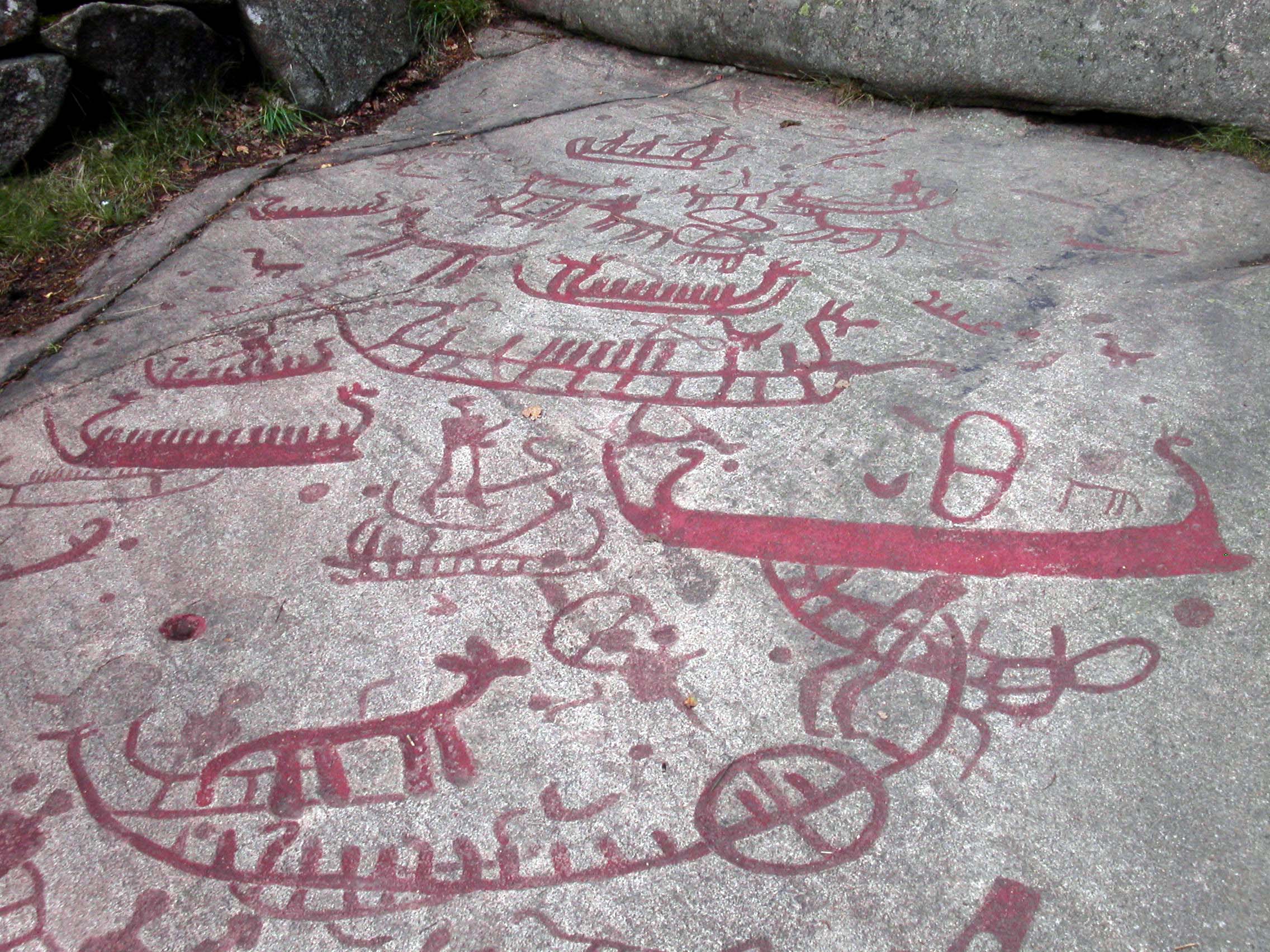
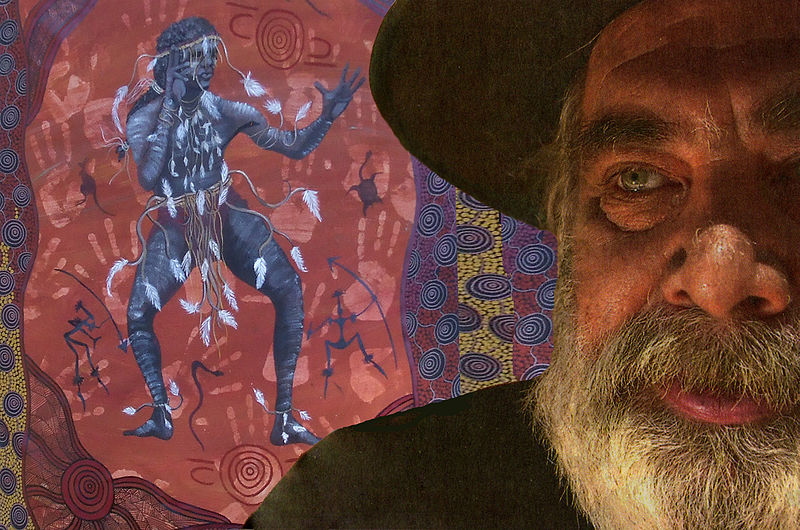
Above:  The rock art of Bohuslan, Sweden.  Photo by Julius Agrippa.  Below:  Contemporary Aboriginal artist Mundara Koorang. Photo by Novyaradnum.

Dance to the Drummer

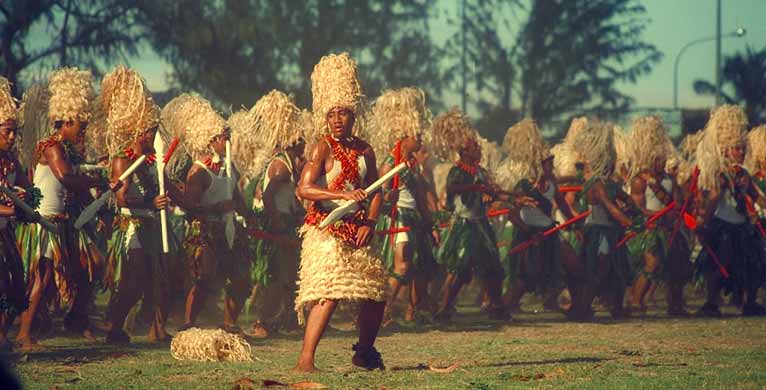
My 88-year-old father is undergoing open-heart surgery today,  so  I will take a short break from blogging.  Tomorrow,   I have a great guest blog lined up. Today, I’m bringing you a cool photo.  It shows Tonga College students performing a traditional Kailao, or war, dance.   I can well believe that these muscular dancers are the descendants of the Lapita people who first paddled across the South Pacific and settled the Polynesian islands.   This photo was taken by James Foster in  1988.

Slavery and the Power of a Story

As an archaeological journalist,  I  long ago learned the value and importance of storytelling.  My articles often open anecdotally,  with a brief  story that I hope will seduce readers into staying with me as I explore the science of a new excavation or find.   I love telling stories,  and if I have good material to work with,  these leads often write themselves.

Story-telling is an immensely powerful medium,  perhaps the most direct and intense way of communicating basic truths that we humans have.  And yet it is one that archaeologists rarely tap into when they try to communicate  their findings to the public. I think this is a great shame,  for the artifacts that archaeologists work with often tell immensely compelling stories,  stories that allow readers to connect strongly with the past.

I was reminded of this today while  listening to a superb online interview with Lonnie Bunch,  the director of an important new museum in the planning stages, The Smithsonian’s National Museum of African-American History and Culture.   Bunch was talking about how Smithsonian curators decide which donations to accept and which to reject,  a topical subject for he had just turned down the suit that O.J. Simpson wore to court on the day of his acquittal.

The  interviewer asked Bunch about the most surprising donations he had received, and this is where the interview took soaring flight,  as Bunch left the tawdry, tabloid story behind.  He described a recent acquisition,  a humble pillowcase that someone had brought in.  It was,  he explained,  embroidered by an enslaved woman who was about to be sold the next day.

The embroidered inscription was for her daughter.  It read:  “In this pillowcase, you will find a dress,  some biscuits,  but what you will [also] find is that it is filled with love,  and,  though you will never see me again,  always know how close you are to my heart.”

For me,  this one humble artifact said more about the horrors of slavery than many lengthy archaeological reports I have recently read about excavations in the slave quarters of southern plantations.  I felt an instant, direct,  immediate connection to that long-ago grieving mother,  as one human being to another.  Bunch clearly knows how to communicate to the public, and I really look forward to seeing this new museum when it opens five years from now.

Moreover,  it seems to me that many archaeologists could learn something important from this museum director.  Sometimes all it takes is one well-chosen artifact with a story to bring the past back vividly to life.

Dolphin Hunters and The Cove

Like many others who watched the Academy Awards last night,  I was very disturbed by the clips I saw from The Cove, the  film that won in the  Best Documentary category.   The Cove portrays the dolphin hunt that takes place each year near the small Japanese fishing village of  Taiji.  There hunters herd more than a thousand dolphins  into a small cove, where they spear them from small boats.  The most disturbing clip was an aerial view of the cove after the slaughter:  the water was blood red.

Taiji’s inhabitants are apparently up in arms now over the film.   According to a CBC report I read today,  Taiji’s mayor has now released a statement defending the hunt. “There are different food traditions within Japan and around the world,”  he notes. “It is important to respect and understand regional food cultures, which are based on traditions with long histories.”

I will come back in a moment to the ethics of this hunt.  But the mayor does make a valid point.  Dolphin hunting does indeed have a very long history along the rim of the Pacific Ocean.  Archaeological evidence shows that dolphins were a major food source along the coast of California–not far from where the Oscars were handed out last night–as early as 9000 years ago.

Mark Raab,  a professor emeritus at the University of California, Riverside,  and his colleagues excavated a trove of dolphin bones at a site on San Clemente Island, 60 miles off the California coast.   As it happened,  I was there at Eel Point with the crew when they dug a small portion of the site, and I was amazed as I watched faunal expert Judy Porcasi sort through the recovered  bone fragments.  Porcasi kept shaking her head as she picked out something familiar in a screen. “Dolphin,” she said.  “Dolphin.  Dolphin.”

Her later analysis showed that a whopping 38 percent of the identifiable mammal bones from the dig belonged to dolphins.   And though the intensity of the hunt varied over time,  the  people of Eel Point hunted dolphins from 7000 B.C.  right up to A.D 1400.   And this raises an important question.  How did they manage kill so many dolphins?  The excavations did not turn up any sign of a harpoon.

In search of clues, Porcasi and Raab began scouring accounts of how traditional cultures elsewhere around the Pacific hunted dolphins.  From this they discovered that human hunters had long employed a simple but deadly technique.

In the Solomon Islands,  for example,   hunters struck stones together underwater: this created a terrible cacophony of sound that essentially “jammed” the animals’ echo-location,  a sonarlike system that guides them underwater.   With this system down, the animals became so disoriented  that hunters easily drove them into shallow water,  where they could then be “captured by hand,”  says Raab.

Raab now argues that the first migrants to Eel Point likely brought this clever hunting technique with them from Asia.  This strikes me as a very plausible argument,  and it suggests  that humans have been hunting dolphins in places like Japan for more than 11,500 years.

But does this make the practice morally acceptable today?   I don’t think it does and here’s why. Japanese villagers do not need dolphin meat to survive,  as hunters did in times past.   And there is no suggestion that hunting these marine mammals plays an essential part of their culture.   Last, but definitely not least,  I think we know much more about dolphins today than hunters did in the past,  because we are able to observe their underwater behavior in ways that earlier people could not.

On the strength of these observations,  we now know how very intelligent dolphins are.  They have recognizable personalities,  can think about the future,  are capable of working together cooperatively,  and are excellent problem-solvers.  In other words, dolphins are a lot like us,  and so  some scientists have recently proposed they should be treated as “non-human persons.”

I do not support the dolphin hunt in Taiji, Japan.  I hope that the international community can now pressure the Japanese government to bring this terrible slaughter to an end.

A Second Life for Çatalhöyük

I have often wanted to climb inside the minds of archaeologists as they wander the sites they know extremely well.  After long years of digging, mapping, and poring over artifacts, they see a ruined temple, ragged stone walls, a hunter’s campsite in a way that the rest of us can never hope to do. They can see in their mind’s eye a site as it may once have been.  The rest of us are chained to the present– a dim shadow of what a place once was.

All this will explain why I am so captivated by a new experimental project undertaken by University of California Berkeley archaeologist Ruth Tringham, Ph.D. student Colleen Morgan and their students. The team is using Second Life, a three-D virtual online world to construct several scenes set at the famous Neolithic site of Çatalhöyük in Turkey.  As some of you will know, Çatalhöyük has been the subject of decades of archaeological research, most recently under the direction of Stanford University archaeologist Ian Hodder.

Over the years, I have read a great deal about Çatalhöyük, including a fine site “biography” by science writer Michael Balter.  But I confess that I never really had a feeling for what the site might have looked like until I saw the Second Life version of Çatalhöyük that Tringham,  Morgan and their students laboriously pieced together.

The students based their reconstruction on research papers they read, but it is by no means an accurate representation of the famous Neolithic site. Rather it resembles a gaming version–a carefully thought out and fun one. I think this is a very cool step in exactly the right direction for presenting archaeology to a larger, and much younger audience. Kudos to Tringham and Morgan and their student team.

Here is a YouTube video of their reconstruction to check out:

You can also go to Second Life directly and check out their reconstruction. Colleen Morgan also has a terrific blog post on this.