All posts by Heather Pringle

ER, Ancient Egypt Style

I’ve  spent many hours over the past week on a cardiac ward in a large urban hospital, visiting my father who is suffering from heart trouble.  Over the last few days, as he and I have taken to strolling the corridors–he leaning on his walker,  and I beside him–I have begun to notice all the many gifts and tributes that grateful heart patients and their families have left behind  for nurses and doctors on the ward.

I’ve never seen so many tokens of gratitude–large engraved plaques;  framed homemade quilts;  original etchings and paintings;  an inscribed and signed moose antler; and a framed eagle feather. All are intended as permanent testaments,  and seem to bear the same phrase, “with heartfelt thanks,”  a mantra,  it seems,  from those who have survived a near-death experience and whose hearts have been healed.

As I walk these corridors,  my thoughts occasionally wander and I am reminded of similar places in the ancient world.  In the Nile Valley,  ancient Egyptians searched for relief from their ailments in sanatoriums in two major temples.   The first of these was in Dendera.   There, according to Bruno Halioua and Bernard Ziskind’s wonderful book, Medicine in the Days of the Pharoahs,  the ill took medicinal waters in a temple dedicated to Hathor, bathing in a series of stone tanks in hopes of  a cure–an approach favored even today by those visiting traditional spas.

And if the waters at Dendera offered little relief,   Egyptian patients had a second recourse.   They could journey to the great temple in Deir el-Bahri,   dedicated to Imhotep and Amenhotep.  There priests conducted the sick into a dark chapel:  as they waited hopefully,  a god-like voice suddenly boomed,  reassuring them that they would be cured.  In other chambers,  priests induced dream states in their patients,  allowing them to talk directly to the gods and plead their cases.

Did any of this succeed in curing the hopefuls?  Well,  the ancient Egyptians,  too, left permanent tokens of their gratitude.   Along the walls of one shrine, Egyptologists have found inscribed testimonials.  One reads:  “Andromachus, a Macedonian, a laborer, came to the good god Amenhotep; he was sick and the god cured him the same day.”

The nurses and doctors on Ward 2a,  where my father now is,  would recognize the sentiment immediately.

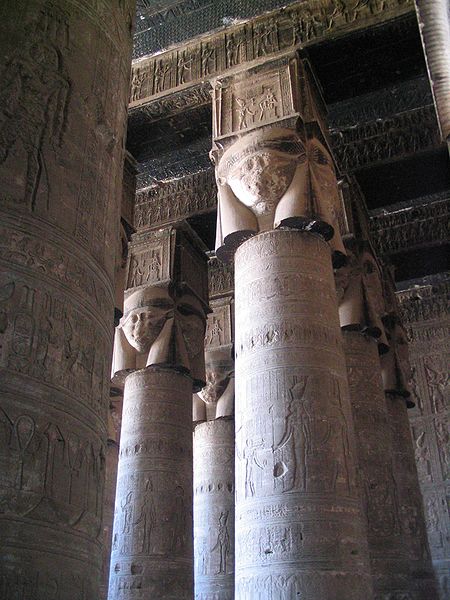
Today’s photo shows the Hathor capitals in the First Hypostyle Hall of Dendera temple. The photo was taken by Jaakko Anttila in  January 2005.

Phoenicians and a Very Big Thirst for Adventure

I confess  I have a great soft spot for the half-mad adventurers who build painstaking replicas of ancient seacraft and then trust their fates to them on long ocean voyages.  Their published narratives speckle my bookshelves–from Thor Heyerdahl’s account of his balsa-wood-raft voyage from South America to the Tuamotu Islands in Polynesia,  to lesser known tomes recounting near-death experiences aboard ox-hide Celtic coracles in the storm-tossed North Atlantic and Viking knarrs navigating iceberg-littered waters off the Newfoundland coast.   The courage of these modern mariners is truly impressive.

The latest in this band of nautical brothers is the crew now sailing around Africa aboard a replica of a 2500-year-old Phoenician ship.  The team,  led by former Royal Navy officer  Philip Beale,  is attempting to recreate what is thought to be the first circumnavigation of Africa by Phoenician sailors around 600 B.C.

The great classical Greek historian Herodotus briefly described this epic three-year-long voyage in The Histories.  According to Herodotus,  the Egyptian pharoah Nekho II commanded a small fleet of Phoenician ships–the master mariners of the day–to explore the African coast from East to West.  After rounding the horn of Africa,  they sailed southward, stopping only to plant and reap grain for ship’s supplies, then passed through the dreaded Pillars of Heracles.  From there,  they returned along the coast of western Africa to Egypt.

Beale and his companions have built what they believe to be a faithful replica of a Phoenician ship of the era,  right down to 8000 olive-wood pins to hold everything together.  Two days ago they docked in the South African port of East London,  and the crew is now preparing to head off to Capetown.  The toughest part of the voyage lies ahead,  as they round the tip of Africa.  If you’re interested in following their voyage,  I’d suggest checking out their info-packed website.  It has a wealth of information on Phoenician history and seafaring.

I certainly wish them kind winds and a safe journey.

The Knights Templar and a Mysterious Nail

A British newspaper, the Telegraph,   reports today that archaeologists working on a tiny  island off the coast of Madeira have recovered a 1st or 2nd century A.D. iron nail from what was once a Knights Templar stronghold.  The story’s headline reads:  “A Nail from Christ’s Crucifixion Found?”

I’d say the Telegraph editors are  taking a few liberties here.  Yes, the nail was reportedly found in a decorated box on the island,  and yes,  the Knights Templar served as a fighting unit in the Crusades during the 12th century, occupying Jerusalem for a time.   But there is absolutely nothing to suggest that Roman soldiers employed this particular nail in the crucifixion of Christ.   In medieval times,  charlatans peddled a wide assortment of fake relics  in the Holy Land:  this could certainly be one of them.

Heart Attacks, Strokes and the Ancient Egyptians

On the weekend,  British researchers  published an intriguing article in Lancet on a group of people whose cravings for fat-saturated junk food led to arteries packed with plaque. The individuals in question weren’t 21st century Brits fatally fond of crisps, chips and deep-fried Mars bars, however.   They were ancient Egyptian priests who had regularly scarfed up left-over cakes and other offerings given by supplicants.

Rosalie David,  an Egyptologist at the University of Manchester and one of the world’s great experts on Egyptian mummies,  headed the team.  She and her colleagues examined  mummies of Egyptian priests and their family members and discovered to their surprise signs of serious heart disease,  including badly clogged and damaged arteries.

Intrigued by this,  David studied inscriptions on Egyptian temples describing the rituals that priests performed and the offerings that supplicants left.  High on the list of the offerings were cooked geese,  whose meat contained up to 60 percent fat, beef,  and an assortment of calorie-laden cakes made of animal fat and oil.

Moreover,  the inscriptions and other texts revealed how priestly foodies  at these temples refused to let all this fat-rich fare go to waste.  After performing rituals with their offerings three times daily,  they gathered up the leftovers and took them home to their families–hardly a heart-smart diet.

David and her colleagues now suggest that this fat-saturated diet and the arterial diseases that resulted could have cut short the  lives of these priests.    Studies of the mummies and other human remains suggest that this group did not often live past the age of 50.

It’s not surprising then that Egyptian physicians were well aware of heart disease, as attested to in the section on cardiovascular disorders in the Ebers papyrus.   Indeed Bruno Halioua and Bernard Ziskind,  the authors of Medicine in the Days of the Pharoahs, marvel at what they call the Egyptians’ “impressive grasp of cardiovascular function.”  As the two authors point out,  the Ebers papyrus even includes a description of  what might well be a heart attack.  An individual, notes the papyrus, “who suffers at the entrance to the inside (ib), when he has pains in his arm, his breast,  and the side of his stomach (ro-ib)” is in dire straits.  “Death is approaching.”

We never think of ancient Egyptians keeling over from heart attacks or strokes.   Those are supposed to be modern diseases,  but it would appear that there really is nothing new under the sun.

World’s Oldest Surviving Junk Food

Quick,  who invented the hot dog?  Was it the sausage-makers of Frankfurt?  The butchers of Vienna ( a city that German-speakers call Wien)?  Or was it Charles Feltman,  an enterprising German immigrant who ran a pie-wagon in Coney Island in 1867? We’ll never know,  but get this.  Construction workers have now excavated the world’s oldest known hot dog frozen in ice below one of Feltman’s buildings on Coney Island.  Mummified and rather revolting looking,  this 140-year old frankfurter is attracting a lot of attention. You can see it for yourself in the CNN video here.   The discoverers  say they want to preserve it,  but they are sure going about it in a weird way–pouring hot water on the ice!

Hot dogs made Feltman a fortune.  In his first year of business,  the young enterpreneur hawked more than 3864 of them to Coney Island visitors,  and he transformed junk food into a small empire of beer gardens,  hotels and the like.

Clearly junk food pays.  Never underestimate the appetite of the public!

The Civil War’s First Scorched Earth

Archaeology magazine has just published a story I wrote on an almost completely forgotten tragedy of the Civil War.  In 1863,  the Union Army razed and laid waste to nearly four counties in Missouri–a year before the better known scorched-earth destruction of Atlanta, Georgia,  by General William Tecumseh Sherman and his forces.  Archaeologist Ann Raab,  a Ph.D. student at the University of Kansas in Lawrence,  and her colleagues are now excavating sites in what is still known as “The Burnt District.”   They are bringing to light a virtually unknown chapter of the Civil War–incredible work. Archaeology has posted an abstract of the article here.  I will have more to say about this story in a future post.

Sailing to Crete More than 130,000 Years Ago?

A few weeks ago,  I posted on intriguing new research from Crete that raises the possibility of ancient human seafarers rafting across  Mediterranean straits more than 130,000 years ago–well before modern humans even left Africa.  I have just written an article on this for National Geographic news,  interviewing several of the team members and obtaining comments from other scientists.  You can find my online article here.

The Ancestral Journey of the Navajo

For years,  anthropologists and archaeologists  have puzzled over the origins of two famous aboriginal groups in the American Southwest:  the Navajo and Apache people. The traditional  languages spoken by the Navajo and the Apache differ strikingly from those of their neighbors,  so much so that if you look at a linguistic map their homelands stand out like islands in a great sea.

But their languages  are very closely related to the mother tongues of aboriginal people living in the subarctic in northwestern Canada and Alaska:  indeed they belong to the same Athapaskan family.  Moreover,   linguists have long suggested that the ancestors of the Navajo and Apache people splintered off from their subarctic cousins roughly 1200 years ago.  This begs a fascinating question.   What might have prompted the ancestral Navajo and Apache to abandon their homeland in the northern forests and  journey thousands of miles south to a very unfamiliar desert?

Some years ago,  University of Alaska archaeologist William Workman proposed a possible answer.   He suggested that the eruption of the  White River volcano in southern Alaska around 1200 years ago could well have driven out both game and human hunters.    Ash from the volcano blanketed a region of some 250,000 square kilometers:  in some parts it reached 1.5 meters in thickness.  All this, observed Workman, could well have forced the region’s Athapaskan speakers  to search for a new homeland in the south.

Yesterday,  a team led by Simon Fraser University researcher Tyler Kuhn shed new light on the dire nature of this eruption.  In a new online paper in Molecular Ecology,  Kuhn and his colleagues compared ancient DNA from caribou bones from the Yukon that dated before and after A. D. 1000.  As the team discovered, the caribou living there before the White River eruption were genetically different from the caribou that resided there after.

In other words,  a big change occurred in the local caribou population around the time of the White River eruption.   The old herds vanished,  and later new caribou herds moved in–quite likely as the land greened and grasses,   sedges, willows and the like took hold once again.

All this strongly suggests that Athapaskan hunters  in the area would have struggled to  survive after the eruption.  And indeed,  archaeological evidence from the Yukon points to a major human transition as well.  Before the eruption, the local hunters  relied on throwing darts as their main weapon.  After the ash fell, however,  the inhabitants favored bow and arrows.

We are still a long way from definitive answers,  but I’d say that it is looking more and more as if immense volcanic ash clouds, sunless days and a terrible  famine   changed the course of North American prehistory,  pushing ancestors of the Navajo and the Apache peoples far to the south.