Category Archives: Archaeology

Ancient Mariners and Boat-Builders

Now here’s an excavation that I think is worth watching. Archaeologists at Gimhae National Museum in South Korea will return next week to the site of Bibong-ri, along the country’s southern coast,  to expand their excavations.   Some five to six years ago, archaeologists  working at the  shell-midden site made a stunning discovery:  the waterlogged hull of an ancient wooden boat.    Subsequent radiocarbon dating revealed that the wooden vessel was 7700 years old–the earliest known boat to date.

At first glance,  this might not seem particularly exciting.  Archaeologists now know that human beings became seafarers at least 50,000 years ago,  when modern humans crossed nearly a dozen straits to reach Australia from Southeast Asia.  And the new archaeological evidence of stone hand-axes from Crete suggests that ancient humans may have been island-hopping  in the Mediterranean 130,000 years ago or earlier.

What kind of watercraft did these early seafarers favor?  We simply don’t know, although some archaeologists speculate that the early mariners from Southeast Asia voyaged to Australia on rafts made from giant bamboo.  But the big problem is that archaeologists have yet to excavate any watercraft from such an early period.

So the discovery of an 7700-year-old boat in a Korean shell midden is a very important one,  giving archaeologists a precious glimpse of Neolithic nautical technology.  Researchers will have a lot of questions.  Was the boat powered by wind and sail,  for example?  Or was it powered by the muscle of human paddlers?   How was it constructed?  How many sailors did it hold?

I find it interesting that three of the world’s oldest known watercraft–the vessel from Bibong-ri;  a 7500-year-old  wooden boat excavated in China; and a 5600-year old logboat unearthed  in Japan–all come from eastern Asia.   Is this merely a coincidence,  based on random preservation of wood at three sites?  Or could this hint at the deep antiquity of boat-building and seafaring in this part of the world, an antiquity that we have yet to plumb?

These are not idle questions.   Archaeologists have long discussed the possibility of a very ancient coastal migration by boat from western Asia to the Americas.   Indeed one possible scenario,  proposed by University of Oregon archaeologist Jon Erlandson,  has ancient seafarers setting out by boat from coastal Japan some 15,700 years ago–during the last Ice Age–and nudging northward along the shores of Asia to those of the New World.   To do so,  these migrants would have needed some kind of sturdy boat–possibly a kayak or ocean-going canoe.

I’m very keen to see what else the Korean team will find at Bibong-ri this time around.    We badly need more information.
Signs of Respect

As regular readers will know,  I  recently fumed here over the poor conservation of a petroglyph-covered  boulder at the Vancouver Museum,  after reading a troubling post over at Northwest Coast Archaeology.   I questioned the wisdom of removing such boulders and slabs from the  places where they were created and installing them in  museums.  I then suggested that the Vancouver Museum repatriate the damaged boulder in question.

Since then,  Northwest Coast has posted more on this disturbing state of affairs, and recently  I received a great email on these issues from George Nicholas, an archaeologist at Simon Fraser University and the director of Intellectual Property issues in Cultural Heritage. George is kindly guest-blogging on this today. -HP


I think the notion that rock art is about more than the images is something that has been largely ignored, certainly by the public, but also by many archaeologists and anthropologists. People often tend to focus on the details of the images, rather than on the context of the rock art. But one doesn’t work without the other.

In his book Ways of Seeing, John Berger notes that before photography, before the age of reproductive technology, one could only see a particular image (such as the Last Supper fresco) in the church in which it was painted. The same obviously holds true for Lascaux and all other rock art.

Taken out of their geographic context, the images are divorced not only from the place itself (which may be imbued with meaning of its own), but also from the emotional landscape and viewscape. I’m sure you’ve been to petroglyph sites where there’s sort of a mystical feel to the place. I find that at the Three Sister’s Rockshelter in British Columbia’s Marble Canyon. The silence of the moss-filled forest that surrounds the blue-grey rock face adds an important dimension to the rock art.

And of course, we approach rock art from the perspective of the western world. Our worldview is based on a set of dichotomies: the distinctions between the natural and supernatural realms; between people and nature; between past, present, and future; between genders, and all the rest. Such distinctions may be absent, however, in many indigenous societies; they may live in a world in which ancestral spirits are part of this existence (owing to lack of separation between past and present; between natural and supernatural realms).

So all of this, then, begs several questions. What does rock “art” really represent?  How are we supposed to view it? What should we do with it, from a heritage preservation perspective? Indeed, is rock art something that should be preserved?

Most western archaeologists would say yes to the latter question.  But in Australia, contemporary Aboriginal persons sometimes paint over ancient images as a way of continually replenishing the world; it is the act of painting that is important (like the creation of Navajo sand paintings used in healing ceremonies, and later destroyed, much to the consternation of western observers).

The Zuni people have a similar tradition.  They carve wooden figurines of their war gods, the Ayahu:ta, and place them in outdoor shrines. After a period of time, the figurines are replaced with new ones. Zuni tribal member and archaeologist Edmund Ladd notes in his writings that “When a new image of the Ahayu:ta is installed in a shrine, the ‘old’ one is removed to ‘the pile,’ which is where all the previous gods have been lain. This act of removal specifically does NOT have the same connotations as ‘throwing away’ or ‘discarding.’ The image of the god that has been replaced must remain at the site to which it was removed and be allowed to disintegrate there.” So, from a Zuni perspective, proper stewardship is letting the ahayu:ta decay.

Rock art raises many fundamental issues,  as well as conflicting claims that certain items of heritage belong to a specific group or are part of the heritage of human kind. In recent decades, archaeologists have been very much part of this debate.

My own position is that I see merit in both positions, but also that the tension between the two positions is important because it forces us (as archaeologists, as heritage managers, as member of descendant communities, etc) to think about the nature of heritage in new ways.

-George Nicholas

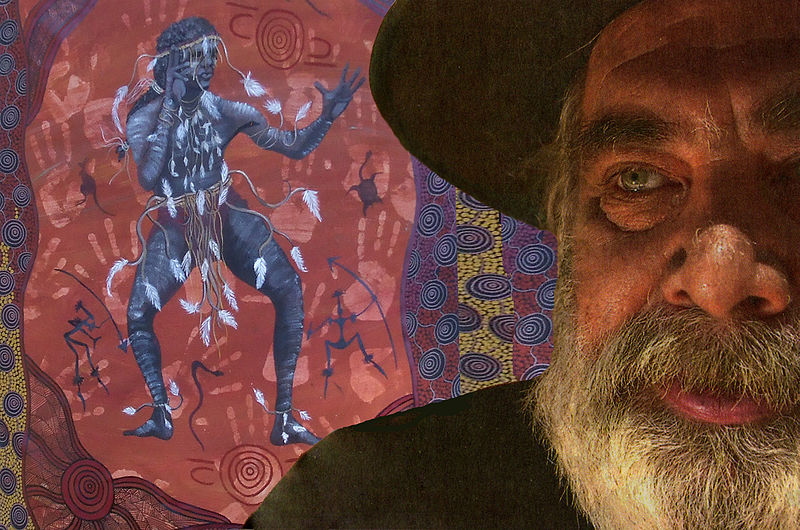
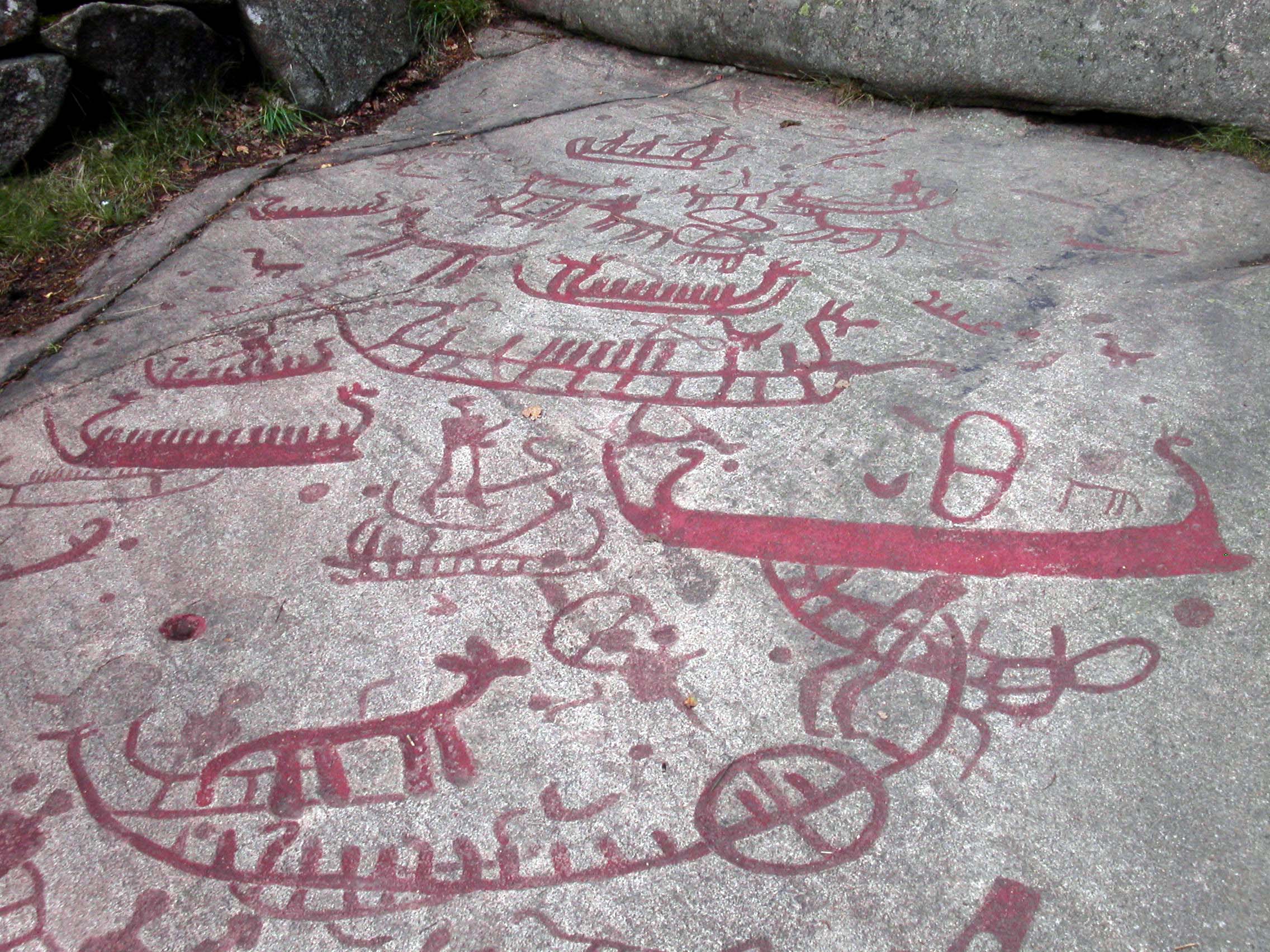
Above:  The rock art of Bohuslan, Sweden.  Photo by Julius Agrippa.  Below:  Contemporary Aboriginal artist Mundara Koorang. Photo by Novyaradnum.

Slavery and the Power of a Story

As an archaeological journalist,  I  long ago learned the value and importance of storytelling.  My articles often open anecdotally,  with a brief  story that I hope will seduce readers into staying with me as I explore the science of a new excavation or find.   I love telling stories,  and if I have good material to work with,  these leads often write themselves.

Story-telling is an immensely powerful medium,  perhaps the most direct and intense way of communicating basic truths that we humans have.  And yet it is one that archaeologists rarely tap into when they try to communicate  their findings to the public. I think this is a great shame,  for the artifacts that archaeologists work with often tell immensely compelling stories,  stories that allow readers to connect strongly with the past.

I was reminded of this today while  listening to a superb online interview with Lonnie Bunch,  the director of an important new museum in the planning stages, The Smithsonian’s National Museum of African-American History and Culture.   Bunch was talking about how Smithsonian curators decide which donations to accept and which to reject,  a topical subject for he had just turned down the suit that O.J. Simpson wore to court on the day of his acquittal.

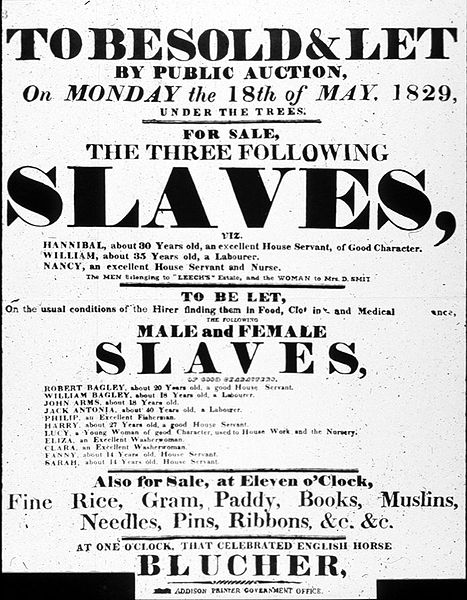
The  interviewer asked Bunch about the most surprising donations he had received, and this is where the interview took soaring flight,  as Bunch left the tawdry, tabloid story behind.  He described a recent acquisition,  a humble pillowcase that someone had brought in.  It was,  he explained,  embroidered by an enslaved woman who was about to be sold the next day.

The embroidered inscription was for her daughter.  It read:  “In this pillowcase, you will find a dress,  some biscuits,  but what you will [also] find is that it is filled with love,  and,  though you will never see me again,  always know how close you are to my heart.”

For me,  this one humble artifact said more about the horrors of slavery than many lengthy archaeological reports I have recently read about excavations in the slave quarters of southern plantations.  I felt an instant, direct,  immediate connection to that long-ago grieving mother,  as one human being to another.  Bunch clearly knows how to communicate to the public, and I really look forward to seeing this new museum when it opens five years from now.

Moreover,  it seems to me that many archaeologists could learn something important from this museum director.  Sometimes all it takes is one well-chosen artifact with a story to bring the past back vividly to life.

Dolphin Hunters and The Cove

Like many others who watched the Academy Awards last night,  I was very disturbed by the clips I saw from The Cove, the  film that won in the  Best Documentary category.   The Cove portrays the dolphin hunt that takes place each year near the small Japanese fishing village of  Taiji.  There hunters herd more than a thousand dolphins  into a small cove, where they spear them from small boats.  The most disturbing clip was an aerial view of the cove after the slaughter:  the water was blood red.

Taiji’s inhabitants are apparently up in arms now over the film.   According to a CBC report I read today,  Taiji’s mayor has now released a statement defending the hunt. “There are different food traditions within Japan and around the world,”  he notes. “It is important to respect and understand regional food cultures, which are based on traditions with long histories.”

I will come back in a moment to the ethics of this hunt.  But the mayor does make a valid point.  Dolphin hunting does indeed have a very long history along the rim of the Pacific Ocean.  Archaeological evidence shows that dolphins were a major food source along the coast of California–not far from where the Oscars were handed out last night–as early as 9000 years ago.

Mark Raab,  a professor emeritus at the University of California, Riverside,  and his colleagues excavated a trove of dolphin bones at a site on San Clemente Island, 60 miles off the California coast.   As it happened,  I was there at Eel Point with the crew when they dug a small portion of the site, and I was amazed as I watched faunal expert Judy Porcasi sort through the recovered  bone fragments.  Porcasi kept shaking her head as she picked out something familiar in a screen. “Dolphin,” she said.  “Dolphin.  Dolphin.”

Her later analysis showed that a whopping 38 percent of the identifiable mammal bones from the dig belonged to dolphins.   And though the intensity of the hunt varied over time,  the  people of Eel Point hunted dolphins from 7000 B.C.  right up to A.D 1400.   And this raises an important question.  How did they manage kill so many dolphins?  The excavations did not turn up any sign of a harpoon.

In search of clues, Porcasi and Raab began scouring accounts of how traditional cultures elsewhere around the Pacific hunted dolphins.  From this they discovered that human hunters had long employed a simple but deadly technique.

In the Solomon Islands,  for example,   hunters struck stones together underwater: this created a terrible cacophony of sound that essentially “jammed” the animals’ echo-location,  a sonarlike system that guides them underwater.   With this system down, the animals became so disoriented  that hunters easily drove them into shallow water,  where they could then be “captured by hand,”  says Raab.

Raab now argues that the first migrants to Eel Point likely brought this clever hunting technique with them from Asia.  This strikes me as a very plausible argument,  and it suggests  that humans have been hunting dolphins in places like Japan for more than 11,500 years.

But does this make the practice morally acceptable today?   I don’t think it does and here’s why. Japanese villagers do not need dolphin meat to survive,  as hunters did in times past.   And there is no suggestion that hunting these marine mammals plays an essential part of their culture.   Last, but definitely not least,  I think we know much more about dolphins today than hunters did in the past,  because we are able to observe their underwater behavior in ways that earlier people could not.

On the strength of these observations,  we now know how very intelligent dolphins are.  They have recognizable personalities,  can think about the future,  are capable of working together cooperatively,  and are excellent problem-solvers.  In other words, dolphins are a lot like us,  and so  some scientists have recently proposed they should be treated as “non-human persons.”

I do not support the dolphin hunt in Taiji, Japan.  I hope that the international community can now pressure the Japanese government to bring this terrible slaughter to an end.

A Second Life for Çatalhöyük

I have often wanted to climb inside the minds of archaeologists as they wander the sites they know extremely well.  After long years of digging, mapping, and poring over artifacts, they see a ruined temple, ragged stone walls, a hunter’s campsite in a way that the rest of us can never hope to do. They can see in their mind’s eye a site as it may once have been.  The rest of us are chained to the present– a dim shadow of what a place once was.

All this will explain why I am so captivated by a new experimental project undertaken by University of California Berkeley archaeologist Ruth Tringham, Ph.D. student Colleen Morgan and their students. The team is using Second Life, a three-D virtual online world to construct several scenes set at the famous Neolithic site of Çatalhöyük in Turkey.  As some of you will know, Çatalhöyük has been the subject of decades of archaeological research, most recently under the direction of Stanford University archaeologist Ian Hodder.

Over the years, I have read a great deal about Çatalhöyük, including a fine site “biography” by science writer Michael Balter.  But I confess that I never really had a feeling for what the site might have looked like until I saw the Second Life version of Çatalhöyük that Tringham,  Morgan and their students laboriously pieced together.

The students based their reconstruction on research papers they read, but it is by no means an accurate representation of the famous Neolithic site. Rather it resembles a gaming version–a carefully thought out and fun one. I think this is a very cool step in exactly the right direction for presenting archaeology to a larger, and much younger audience. Kudos to Tringham and Morgan and their student team.

Here is a YouTube video of their reconstruction to check out:

You can also go to Second Life directly and check out their reconstruction. Colleen Morgan also has a terrific blog post on this.

ER, Ancient Egypt Style

I’ve  spent many hours over the past week on a cardiac ward in a large urban hospital, visiting my father who is suffering from heart trouble.  Over the last few days, as he and I have taken to strolling the corridors–he leaning on his walker,  and I beside him–I have begun to notice all the many gifts and tributes that grateful heart patients and their families have left behind  for nurses and doctors on the ward.

I’ve never seen so many tokens of gratitude–large engraved plaques;  framed homemade quilts;  original etchings and paintings;  an inscribed and signed moose antler; and a framed eagle feather. All are intended as permanent testaments,  and seem to bear the same phrase, “with heartfelt thanks,”  a mantra,  it seems,  from those who have survived a near-death experience and whose hearts have been healed.

As I walk these corridors,  my thoughts occasionally wander and I am reminded of similar places in the ancient world.  In the Nile Valley,  ancient Egyptians searched for relief from their ailments in sanatoriums in two major temples.   The first of these was in Dendera.   There, according to Bruno Halioua and Bernard Ziskind’s wonderful book, Medicine in the Days of the Pharoahs,  the ill took medicinal waters in a temple dedicated to Hathor, bathing in a series of stone tanks in hopes of  a cure–an approach favored even today by those visiting traditional spas.

And if the waters at Dendera offered little relief,   Egyptian patients had a second recourse.   They could journey to the great temple in Deir el-Bahri,   dedicated to Imhotep and Amenhotep.  There priests conducted the sick into a dark chapel:  as they waited hopefully,  a god-like voice suddenly boomed,  reassuring them that they would be cured.  In other chambers,  priests induced dream states in their patients,  allowing them to talk directly to the gods and plead their cases.

Did any of this succeed in curing the hopefuls?  Well,  the ancient Egyptians,  too, left permanent tokens of their gratitude.   Along the walls of one shrine, Egyptologists have found inscribed testimonials.  One reads:  “Andromachus, a Macedonian, a laborer, came to the good god Amenhotep; he was sick and the god cured him the same day.”

The nurses and doctors on Ward 2a,  where my father now is,  would recognize the sentiment immediately.

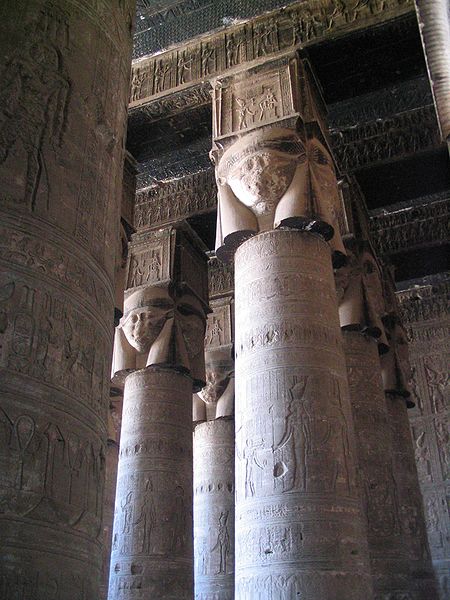
Today’s photo shows the Hathor capitals in the First Hypostyle Hall of Dendera temple. The photo was taken by Jaakko Anttila in  January 2005.

Phoenicians and a Very Big Thirst for Adventure

I confess  I have a great soft spot for the half-mad adventurers who build painstaking replicas of ancient seacraft and then trust their fates to them on long ocean voyages.  Their published narratives speckle my bookshelves–from Thor Heyerdahl’s account of his balsa-wood-raft voyage from South America to the Tuamotu Islands in Polynesia,  to lesser known tomes recounting near-death experiences aboard ox-hide Celtic coracles in the storm-tossed North Atlantic and Viking knarrs navigating iceberg-littered waters off the Newfoundland coast.   The courage of these modern mariners is truly impressive.

The latest in this band of nautical brothers is the crew now sailing around Africa aboard a replica of a 2500-year-old Phoenician ship.  The team,  led by former Royal Navy officer  Philip Beale,  is attempting to recreate what is thought to be the first circumnavigation of Africa by Phoenician sailors around 600 B.C.

The great classical Greek historian Herodotus briefly described this epic three-year-long voyage in The Histories.  According to Herodotus,  the Egyptian pharoah Nekho II commanded a small fleet of Phoenician ships–the master mariners of the day–to explore the African coast from East to West.  After rounding the horn of Africa,  they sailed southward, stopping only to plant and reap grain for ship’s supplies, then passed through the dreaded Pillars of Heracles.  From there,  they returned along the coast of western Africa to Egypt.

Beale and his companions have built what they believe to be a faithful replica of a Phoenician ship of the era,  right down to 8000 olive-wood pins to hold everything together.  Two days ago they docked in the South African port of East London,  and the crew is now preparing to head off to Capetown.  The toughest part of the voyage lies ahead,  as they round the tip of Africa.  If you’re interested in following their voyage,  I’d suggest checking out their info-packed website.  It has a wealth of information on Phoenician history and seafaring.

I certainly wish them kind winds and a safe journey.

The Knights Templar and a Mysterious Nail

A British newspaper, the Telegraph,   reports today that archaeologists working on a tiny  island off the coast of Madeira have recovered a 1st or 2nd century A.D. iron nail from what was once a Knights Templar stronghold.  The story’s headline reads:  “A Nail from Christ’s Crucifixion Found?”

I’d say the Telegraph editors are  taking a few liberties here.  Yes, the nail was reportedly found in a decorated box on the island,  and yes,  the Knights Templar served as a fighting unit in the Crusades during the 12th century, occupying Jerusalem for a time.   But there is absolutely nothing to suggest that Roman soldiers employed this particular nail in the crucifixion of Christ.   In medieval times,  charlatans peddled a wide assortment of fake relics  in the Holy Land:  this could certainly be one of them.

Heart Attacks, Strokes and the Ancient Egyptians

On the weekend,  British researchers  published an intriguing article in Lancet on a group of people whose cravings for fat-saturated junk food led to arteries packed with plaque. The individuals in question weren’t 21st century Brits fatally fond of crisps, chips and deep-fried Mars bars, however.   They were ancient Egyptian priests who had regularly scarfed up left-over cakes and other offerings given by supplicants.

Rosalie David,  an Egyptologist at the University of Manchester and one of the world’s great experts on Egyptian mummies,  headed the team.  She and her colleagues examined  mummies of Egyptian priests and their family members and discovered to their surprise signs of serious heart disease,  including badly clogged and damaged arteries.

Intrigued by this,  David studied inscriptions on Egyptian temples describing the rituals that priests performed and the offerings that supplicants left.  High on the list of the offerings were cooked geese,  whose meat contained up to 60 percent fat, beef,  and an assortment of calorie-laden cakes made of animal fat and oil.

Moreover,  the inscriptions and other texts revealed how priestly foodies  at these temples refused to let all this fat-rich fare go to waste.  After performing rituals with their offerings three times daily,  they gathered up the leftovers and took them home to their families–hardly a heart-smart diet.

David and her colleagues now suggest that this fat-saturated diet and the arterial diseases that resulted could have cut short the  lives of these priests.    Studies of the mummies and other human remains suggest that this group did not often live past the age of 50.

It’s not surprising then that Egyptian physicians were well aware of heart disease, as attested to in the section on cardiovascular disorders in the Ebers papyrus.   Indeed Bruno Halioua and Bernard Ziskind,  the authors of Medicine in the Days of the Pharoahs, marvel at what they call the Egyptians’ “impressive grasp of cardiovascular function.”  As the two authors point out,  the Ebers papyrus even includes a description of  what might well be a heart attack.  An individual, notes the papyrus, “who suffers at the entrance to the inside (ib), when he has pains in his arm, his breast,  and the side of his stomach (ro-ib)” is in dire straits.  “Death is approaching.”

We never think of ancient Egyptians keeling over from heart attacks or strokes.   Those are supposed to be modern diseases,  but it would appear that there really is nothing new under the sun.