All posts by Heather Pringle

Herman Wirth and the Origins of Writing

Did our early human ancestors develop a  written “code” some 30,000 years ago or more, inscribing and painting cave walls with its enigmatic symbols?  This is the question posed by new research from Genevieve von Petzinger,  a recently graduated master’s student at the University of Victoria in British Columbia, and the subject of a fascinating new article in New Scientist.  What no one has mentioned so far, however,  is that the  idea of such an ancient script dates back to the nineteenth century and has a dark link to Nazi Germany.

First,  however,  let me summarize my understanding of von Petzinger’s very cool new research.  Struck by the profusion of little circles,  triangles,  lines and other marks on rock-art-covered cave walls dating to Paleolithic times,  von Petzinger created a massive database of all such recorded marks at 146 sites in France.  (No one else had apparently been willing to undertake this seemingly thankless task, so full marks to von Petzinger.)  The sites  ranged in age from 35,000 to 10,000 years ago.

In analyzing this new database with her thesis advisor April Nowell,  von Petzinger noticed that cave artists had repeated 26 different signs–including circles and triangles–over and over again. The artists had also used a kind of visual shorthand–inscribing just mammoth tusks instead of a whole mammoth, for example–which is common in pictographic languages.   Moreover,  in some caves,  von Petzinger discovered pairs of signs,  a type of grouping that characterizes early pictorial language.

This all sounds exceedingly interesting,  though I am waiting to see the paper that the pair has just submitted to Antiquity. But I feel obliged to point out that the idea of a very early system of written symbols was strongly championed in Germany in the 1920s and 1930s by Herman Wirth,  one of the most controversial prehistorians in Europe and the first president of the Nazi research institute founded by SS head Heinrich Himmler.   (This institute was the subject of my last book,  The Master Plan:  Himmler’s Scholars and the Holocaust.  In it,  I wrote two full chapters on Wirth and his research. )

Wirth,  who had a Ph.D in philology,  was a man of great personal charm and many bizarre ideas.  He became convinced that a blonde-haired, blue-eyed Nordic race had evolved in the Arctic,  where it developed a sophisticated civilization complete with the world’s first writing system.  Furthermore, he proposed that Plato’s description of Atlantis and its demise was in fact an accurate account of the catastrophe that befell the Nordic civilization on an Arctic  island.

According to Wirth,  the Nordic refugees from this  disaster escaped to northern Europe,  bringing with them their ancient writing system,  an invention that later diffused to cultures around the world.   So Wirth spent years poring over ancient European rock art, searching for evidence of this system and recording examples of circles,  disks and wheels that he believed were ancient Nordic ideograms symbolizing the sun,  the annual cycle of life,  and so on.

I found Wirth’s ideas about an ancient master race and an Arctic Atlantis preposterous.  Indeed,  they would have been laughable  had it not been for the fact that Himmler,  the architect of the Final Solution,  used Wirth’s published works  to lend credence to the official Nazi line on the Aryan master race,  and that Wirth, who died in 1981,  still has many avid followers in Germany and Austria today. Indeed,  I  interviewed one of his ardent supporters.

I think that von Petzinger’s new research on Paleolithic symbols sounds immensely intriguing.  It certainly fits with our growing awareness of the abilities of our human ancestors.  Moreover,  I  want to state clearly that the Canadian researcher did not for a moment come under the influence of Herman Wirth and his ideas.  Indeed, she proposes that the ancient sign language may have originated in Africa and arrived in Europe with modern humans–a proposal that would have horrified Wirth.

Nevertheless,  I think it’s  important to point out the troubled history of the idea of an ancient European script recorded in rock art.    We cannot afford to forget in any way the Nazi past.

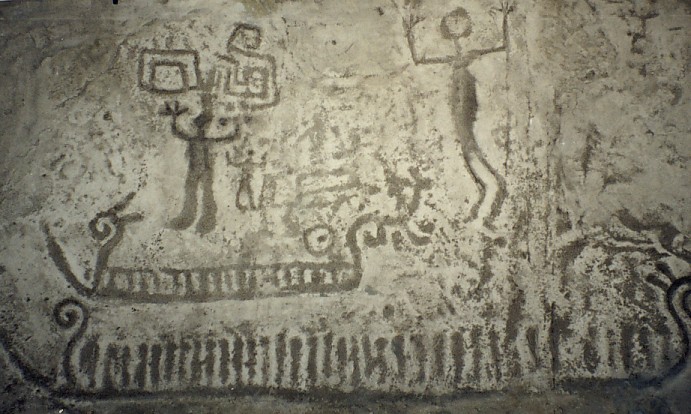
Today’s photo shows a plaster cast that Wirth made in the late 1930s of Bronze-Age rock art in Sweden.  I photographed this cast in 2002 as it hung in a museum in a small Austrian town, Spital am Pyhrn.  At the time,  Wirth’s casts were clandestine Nazi memorials.

A Week in the Life of an Archaeological Journalist

It’s been a long week full of very late nights.  I’ve been burning the midnight oil for several days now to finish two very cool archaeological stories for the news department at Science magazine.   I can’t tell you what they are about at the moment,  but I can say that I have been on the phone much of this week to two very different worlds.

One story came from West Africa,  where the cell phone connection crackled terribly during my phone calls and where one beleaguered researcher was having a lot of trouble picking up his emails.   I really admire African archaeologists:  they often work under incredibly adverse circumstances–barebone funding,  miniscule technology,   rapacious looting, and a whole lot of archaeologically unknown territory.  One researcher I interviewed last year for a story  was trying to excavate in a very politically troubled part of Central African Republic.   He daily feared for the security of his crew.

My other archaeological story this week could hardly have been more different.  It was centered in Silicon Valley,  and I spent long hours on phone with several NASA men who spoke effortlessly in aerospace acronym-ese.   Planetary scientists and payload experts,  they had the opposite problem from the Africans– so much cutting-edge technology,  so many satellites, orbiters,  probes and the like,   that they hardly knew what to do with them.

One of the reasons that I became a science journalist is because I love to learn new things and savor new experiences.  It was clearly the right career choice.   I had a lot of fun this week,  journeying back and forth between Silicon Valley and the remote bushlands of Western Africa.

Today’s photo shows Apollo 11 Lunar Module Pilot Buzz Aldrin’s bootprint. It was taken on July 20, 1969.

Exhuming Ancient Celebrities

I wasn’t planning to post today on Tutankhamun.  Over the past twenty-four hours,  journalists have spilled a cargo tanker’s worth of ink on news that the famous young king suffered from a host of serious ailments.  I thought I would leave the story to the newspapers until I began browsing the coverage.   Some reporters derided the Egyptian king as “malarial and inbred,”  while others took lower aim.  One online rag, for example,   informed readers  that “King Tut was a wreck, but his penis was ‘well-developed’.”

If you ask me,  these exhumations and studies of ancient kings and other celebrities are  becoming media circuses.   All the high-tech poking and prodding quickly strips away the dignity and grandeur of great men and women,  baring their physical  frailties and secrets for all to see.  In recent years,  we’ve been subjected to several of these tawdry sideshows and I suspect there are more to come.  I posted recently on the proposal to exhume Leonardo da Vinci.  And two weeks ago, I spotted an article on a Danish team who will soon exhume a famous 17th century astronomer, Tycho Brahe.

None of the subjects,  I might add,  has given consent for such scientific study.  And I sometimes wonder about the motives of the researchers.  The scientists who propose to exhume Tycho Brahe, for example,  want to determine whether the famous astonomer was murdered or whether he died of natural cause.   This hardly seems reason enough to rifle through a tomb and disturb the sleep of the astonomer.

In future,  I’d like to see researchers and reporters alike treat the ancient dead in the same way we treat the recently deceased–with respect and decorum.   Few of us would consider prying open a recent grave and poring over newly buried remains  just to satisfy a point of  idle curiosity.  So why is it ok to do that to a 17th century astronomer?

When I was writing my book,  The Mummy Congress,  I was really struck by the highly professional way that serious mummy researchers treated the ancient dead. They never made  jokes at the expense of the dead or  talked lightly or unfeelingly about their ailments.  Indeed, during the examinations of the bodies,  they often spoke as if the mummies themselves could hear exactly what was said.

Poor Tutankhamun.  I’m glad he couldn’t hear what people were saying today.

Pirouetting in the Street over Bronze-Age Wreck

Every once in a while,  an archaeological discovery comes along that makes me feel as if I should leap out of my chair, cartwheel across the room,  and turn pirouettes in the street.  I had one of those days yesterday, when I read the British newspaper accounts of an absolutely stunning underwater discovery off the coast of South Devon.  The  South West Maritime Archaeological Group has discovered the debris field of a Bronze-Age trading vessel,  dating back to 1300 B.C.

This is one of the oldest known shipwrecks in the world.  And what makes me so very, very happy about it is that this immensely important find  is in the hands of serious archaeologists whose sole objective is to advance scientific knowledge –not corporate treasure hunters driven by the bottom line.  Hallelujah!

I have long worried about ancient underwater sites such as this in British waters. The British government,  I am sorry to report,  has failed miserably to step up to the plate when it comes to protecting shipwreckl sites.   Although the Britannia long ruled the waves as a great maritime power,   the British government has so far refused to sign the UNESCO Convention on the Protection of the Underwater Cultural Heritage, a vital piece of  international law protecting prehistoric and historic wrecks from the clutches of treasure hunters.   Thirty-one other nations, however,  have taken the much-needed plunge.

So the discovery of the South Devon site and its astonishing cargo of gold bracelets, rapiers,  sling shots,  tin ingots and the like by devoted avocational underwater archaeologists  is cause for real rejoicing.   Ben Roberts,  an archaeometallurgist and curator at the British Museum, couldn’t be happier.  “The Salcombe site,” he notes,  “is now one of the most important Bronze Age sites currently being investigated in Britain.”

Those interested in learning more about this  amazing discovery can read about the work up until 2006 here,  and can then follow the story to the present here.

Soma, Ephedra and Journeys to the Next World

For the last few days  I have been reading a superb book  about a harrowing journey that 26 undocumented Mexican migrants took  in May 2001 across the Sonora Desert in hopes of reaching Arizona,  and last night it got me thinking, strangely enough,  about soma,  an ancient intoxicating ritual drink mentioned frequently in the Vedas and other sacred texts in Iran.  What’s the connection?  Well,  bear with me.  I think you’ll find this interesting.

The book in question is Luis Alberto Urrea’s The Devil’s Highway,  and it’s a riveting account of the perils that this ill-prepared group of Mexican men and boys faced on their lethal trek through the Arizona desert.  As Urrea points out, many of the guides who accompany such parties into the desert insist that their charges pop fistfuls of ephedra-based diet pills.  The pills,  says Urrea are  a “chemical prod to speed up their walkers….A dose of eight pills at a time really gets them hustling. ”

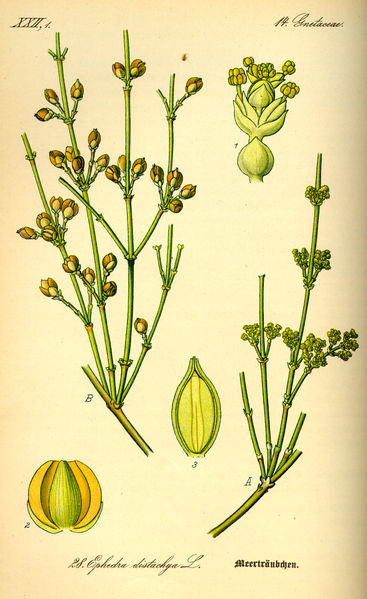
The mention of ephedra really caught my attention.  There are several species in the genus Ephedra,  but they are all unprepossessing, shrubby,  desert-loving plants and several species contain an important stimulant– ephedrine–that produces an adrenaline-like rush in strong doses, and,  in some reported cases, a state of hallucination.

I have been reading a lot in recent weeks about ephedra,  for these plants are found in lavish quantities in the 4000-year-old  graves of Bronze-Age mummies  in the deserts of China’s remote Tarim Basin. As some of you will know,  the Tarim Basin mummies are very famous and controversial,  largely because they are  European in appearance and in the technology they possessed.  (Think plaid woolen clothes.)  As such,  they clearly indicate contact between East and West far earlier than previously believed.

Now here’s the thing.  The fact that archaeologists have uncovered so much ephedra in these graves suggests that it served a very important ritual purpose,  most likely to spur on the spirit of the deceased as it took the long,  dangerous  journey to the next world.

Could the Bronze-Age inhabitants of the Tarim Basin have brought knowledge of ephedra from lands to the west,  such as Iran?  And could ephedra have been one of the plants used to brew soma,  the sacred drink that ancient priests and others imbibed in order to journey to the other world?

Two American researchers,  David Stophlet Flattery and Martin Schwarz,  lay out in minute detail the available scientific evidence for soma in their 1989 book,  Haoma and Harmaline:  The Botanical Identity of the Indo-Iranian Sacred Hallocinogen.  Researchers have long debated possible  ingredients.   But after detailed study,  Flattery and Schwarz concluded that ephedra was one of the key ingredients in the fabled drink.

There are dissenters and doubters of course.   But I think there is something very poignant here.  Illegal Mexican migrants swallow ephedrine pills by the handful today in order to get to a place they think of as the promised land.   But the ephedrine does them no good at all.

Each year, the American border patrol finds hundreds of their bodies lying out in desert.

Sweet Tooth: Victorian style

For anyone who has been caught empty-handed in terms of a gift for Valentine’s Day,  it’s not too late to pop into the kitchen.  New York Times columnist Amanda Hesser has resurrected a Victorian recipe for chocolate caramels and given it to two prominent New York chefs to  update.  The results sound delectable,  and the column is well worth a quick read.

Lovesick in Pompeii

In honor of the patron saint of romances, St. Valentine,   whose day rapidly approaches,  I thought I’d bring you something very different today–the expressions of love carved upon the walls of Pompeii some 2000 years ago.   This proved to be a little trickier than you might expect at first blush,  for many of the Pompeiian inscriptions are wonderfully raunchy.  The Romans really loved sex and weren’t at all bashful about publicizing their talents in the sack.    So  I had to be a little  selective.

First a word about where I found these wonderful translations. The Italian archaeologist and epigrapher Antonio Varone,  who works in an office building tucked away on the grounds of  Pompeii,  has written a superb book on the inscriptions:  Erotica Pompeiana:  Love Inscriptions on the Walls of Pompeii.   While nearly everyone who visits the ancient resort town notices all kinds of  graffiti scratched on the stone of villas and public buildings, very few possess sufficient knowledge of the  Latin language or Roman culture  to decipher the inscriptions.  Thank you Antonio Varone for opening our eyes.

Ok,  bring on the inscriptions.  First the lovesick:

“Vibius Restitutus slept here alone,  longing for his Urbana.”

“Girl,  you look lovely to Ceius and many others.”

Next, the tender:

“So may you forever flourish, Sabina; may you acquire beauty and stay a girl for a long time.”

The jealous:

Who is it that spends the night with you in happy sleep?  Would that it were me.  I would be many times happier.

The  wry:

“Warmest regards from Puddle to her Fishlet.”

The angry:

“Virgula to her Tertius:  you are loathsome.”

“Erotarin, you jealous old fool.”

The boastful:

“No one’s a real man unless he’s loved a woman while still a boy.”

“Restitutus has often seduced many girls.”

The feminist version:

“Euplia was here with thousands of good-looking men.”

The contented:

“I would not sell my husband…for any price…”

The proud  new parents:

“Cornelius Sabinus has been born.”

What I love most about these inscriptions is their immediacy.  I feel as if I know these people,  as if for a moment or two,  I can share their thoughts across the great dark chasm of time.

Another Step Closer to Waking the Dead

This has been quite a week for ancient DNA stories.  First, the feature article in Archaeology magazine about the possibility of Neanderthal cloning.  And yesterday,  a research paper in Nature reporting the success of an international team in reconstructing the ancient genome of a 4000-year-old man from northwestern Greenland.

The latter project clearly takes us one step closer towards the ability to clone a Neanderthal,  the subject of my last two posts.   But today,  I’d to focus on the new research from Greenland and what I think is important about it.

The team, led by Eske Willerslev,  a very, very  media-savvy researcher at the University of Copenhagen (whose work I have posted on before), obtained its ancient DNA from a tuft of human hair  excavated by an archaeological team in 1986 from a site in northwestern Greenland.  Willerslev and his colleagues make a strong claim that they have ruled out modern contamination.

The archaeologist who excavated the hair has gone on record stating in the 87 pages of supplementary material posted by  Nature that none of the ethnic Greenlanders on his team touched the sample.   He also affirms that no one who was likely of Asian descent handled the hair later during its storage in the museum.

So the team does indeed seem to be working with an uncontaminated ancient sample.  And Willerslev–an expert on ancient DNA–and his Ph.D. student Morten Rasmussen report that the team has reconstructed 80 percent of the nuclear genome.  Based on this,  the team has learned a number of things.

Number one,  the hair belonged to a man who descended from northern-eastern Siberians who migrated to the New World as early as 6400 years ago.  Number two,  the individual in question had blood type A+, brown eyes,  dark skin,  a predisposition to baldness, a genetic adaptation to polar cold,  and other identifiable traits.

Archaeologists already knew, however,  from decades of painstaking study of artifacts that the early Greenlanders descended from northern Asian migrants.   No surprises there.  What is new,  and I think very exciting,  are all the  details of appearance and physiology that have come to light about this particular  individual– gleaned from just a few hairs.

Archaeology has never been very good at getting down to the level of the individual, particularly in that vast expanse of time we call prehistory.   Excavations of  house floors,  middens,  and shell mounds supply a lot of information on families,  communities and populations.   But they rarely say much if anything about individuals.  And in places like North America,  archaeologists try very hard now to avoid digging human remains–a major source of information about individuals–out of respect for Native American beliefs.

So this new ability to glean a lot of information about an individual from a human hair is bound to come in extremely handy,  and I applaud the Danish team for their success.   But its clear to me that such techniques are yet another worrying step along the road to cloning an ancient human or an ancient hominin.

The Danish led team is trying to calm our fears.  “The genome we’ve reconstructed is no Frankstein’s monster,”  team member Rasmussen told EurekAlert!.  “It’s more like we’ve got the blueprints for a house, but we don’t know how to build it.”

For how long,  I wonder.  How long.

Reconstruction/drawing of Inuk by Nuka Godfredtsen.

Politics, Science and the Cloning of Neanderthals

As some of you will know,  I posted yesterday on the ethics of cloning a Neanderthal,  a subject I have been thinking about after reading an article Zach Zorich wrote for Archaeology magazine. Today Zach left a thoughtful response in the comments section of that post,  raising a number of key points.  I’d like to reply.

But first let me briefly summarize  Zach’s remarks. He notes that all the researchers he interviewed for the piece are well aware of the ethical dilemmas of such cloning and that each had given serious thought to these matters–even though such clones are clearly somewhere off in the future.

Then Zach took exception to the comparison I made between the science of creating a Neanderthal clone and Stalin’s desire to fabricate an army of “humanzees”,  human-chimpanzee hybrids.   As Zach points out, “this isn’t some mad scientist’s scenario for world domination.”  Cloning research, he points out, is part and parcel of a larger picture of legitimate medical research,  and any heavy-handed legislation to prevent Neanderthal cloning could wreak havoc with projects designed to extend and protect human life.

I see Zach’s points here, and I share his concerns about heavy-handed legislation.  I’d hate to see a law block an entire line of desperately needed medical research.  But having said that,  I still can’t shake off my anxiety about what could happen further down the road if and when science is indeed capable of cloning a Neanderthal.

Even well-meaning scientists, after all,  are unable to foresee all the consequences of their research,  as some have discovered to their rue.   In the 1960s,  for example, Norwegian researchers developed a new and very lucrative technology for ocean net-pen farming of Atlantic salmon.  So great were the profit margins that a bedazzled Canadian government agreed to permit the same technology–with the same fish–on the British Columbia coast.  Large corporations began farming Atlantic salmon in pens off the British Columbia coast in 1984, leading to the escape of tens of thousands of these alien fish into the  Pacific Ocean.  Today Atlantic salmon gobble up wild food and threaten native salmon species.

So even when guided by the best of all possible intentions,  scientists can create futures they never envisioned.  And it seems to me that when the stakes include the creation of another of our close human relatives that we need to exercise extra special care.  I think that means taking  into account worse -case scenarios, even one as dire as the intentional creation of Neanderthal clones by a malevolent political regime for the purpose of slave labor.

As Zach notes in his comments (and  I should mention in the interests of full disclosure that I know Zach and that he is my editor at Archaeology), my worst-case scenarios do indeed draw on the research I did for my book on Hitler’s archaeologists.  In fact, one of the things that struck me most forcibly during my four years of research and writing on the book was how terribly susceptible science is to political influence.

Most scientists need laboratories,  expensive research equipment,  and academic appointments  in order to pursue their research.  Corrupt regimes know this and they reward pliable scientists with prestigious jobs and ample research funds.  Conversely, they weed out their opponents from universities and cut off their research funding.  In Nazi Germany,  these simple strategies convinced many scientists to pursue lines of state-approved racial research that they would probably have never considered otherwise.   It could certainly happen again.

All this is to say I’m very uneasy with where this cloning research might lead us in the years to come.  I’d like to see legislators at the UN draw a line in the sand.  Cloning research for medical purposes is an important pursuit.  I’m all in favor of it.   But we should never allow cloning experiments to create Neanderthals.