All posts by Heather Pringle

The Accidental Discoverer on Skye

I read with real delight today the BBC  news  story about the Hebridean farmer who turned up a possible Viking anchor on the Isle of Skye.   The farmer,  Graeme Mackenzie,  was out trying to clear the drain from a pasture he wanted to turn into a potato field,  when,  lo and behold, he came across  what  looked to be a 10-cm-long rusted iron spike.   When Mr. Mackenzie went to pry it out, the piece of iron seemed to go on and on under the peat,  and eventually he had himself  a four-foot-long medieval anchor.

I have a great fondness for people who stumble upon important artifacts while out puttering around the garden or pasture,  and who then report their treasure to the authorities.  First of all, these accidental discoveries always open up the tantalizing possibility that any one of us could unearth something really crucial to archaeology while digging a new flower bed,  say, or putting in a  garage–especially if you live in the British Isles.   Moreover, people who find these dirt-crusted marvels often say really wonderful things to reporters,  quite off the cuff. Mr. Mackenzie, a former skipper,  admitted with modest pride,  for example,  to having ” some knowledge on anchors.”  He then went on to lay out his argument for the anchor being of Viking origin.  ” The metalwork,” he said, ” is totally different from the modern anchors.  It felt like a blacksmith had hammered it.  On the internet I saw a picture of a Viking anchor and it looked exactly the same as mine.”

Whether or not this will prove to be a Viking anchor,  however, remains to be seen.  Viking ship experts will want to take a very close look at the evidence before making any pronouncements.  But a Viking find of this nature would be very important for the Isle of Skye. History tells us that the Norse were a major presence on this North Atlantic  island from the 9th to the mid-13th century A.D.   Indeed,  there’s an absolutely fabulous line from a 13th century Norse saga,  Heimskringla,  about an ancient battle in Skye:    “The hunger battle-birds were filled in Skye with blood of foemen killed.”

But for all the long Norse presence on  Skye,  rather few Norse artifacts have yet turned up.  I sincerely hope,  for the sake of all Norse historians and archaeologists and all the Hebrideans who take such pride in their Norse heritage,  that Mr. Mackenzie is right about the Viking anchor.

By Heather Pringle
Pretty, Sparkly Things

Why did human beings first begin working metal?   A very cool new paper in December’s Antiquity reveals that the desire to beautify the human body had much to do with it.

An international team led by Benjamin Roberts,  a curator at the British Museum, scoured the scientific literature for the earliest known evidence of metal-working.  The paper trail led them to northeastern Iraq.   There,  at two sites,  Shanidar Cave and Zawi Chemi, pastoralists and farmers in the 11th century BCE left behind copper beads and pendants.  Human vanity,  it appears,  spurred early metalworkers to experiment with sparkly, blue-green copper ores.

I was a little perplexed at first by this mention of Shanidar Cave.  As some readers will know, Shanidar is most famous as a Neanderthal burial site.   Perched above the Zab River,  the cave was excavated in the 1950s by Ralph and Rose Solecki,  who recovered  remains of several Neanderthals,  including some who appear to have been deliberately buried.  When pollen experts analyzed soil samples from the cave,  they detected high levels of flower pollen– evidence,  in the view of Ralph Solecki  and his colleague Andre Leroi-Gourhan,  that Neanderthal mourners had ritually blanketed the body in flowers,   a very modern-human kind of behavior.   This research captured the public imagination,  and Ralph  Solecki’s later book,  Shanidar, The First Flower People,  is said to have  inspired writer Jean Auel,  whose novel Clan of the Cave Bear became a bestseller.

Critics,  however,  have long disputed this interpretation.  The excavators,  they note, detected no sign of a grave pit:  indeed it is very possible that the Neanderthal in question perished in an unfortunate accident,  when a large rock  slab fell from the cave ceiling.  That just leaves the famous pollen evidence.  But the skeptics have a very different take.  They suggest that it could have blown in during the excavation.

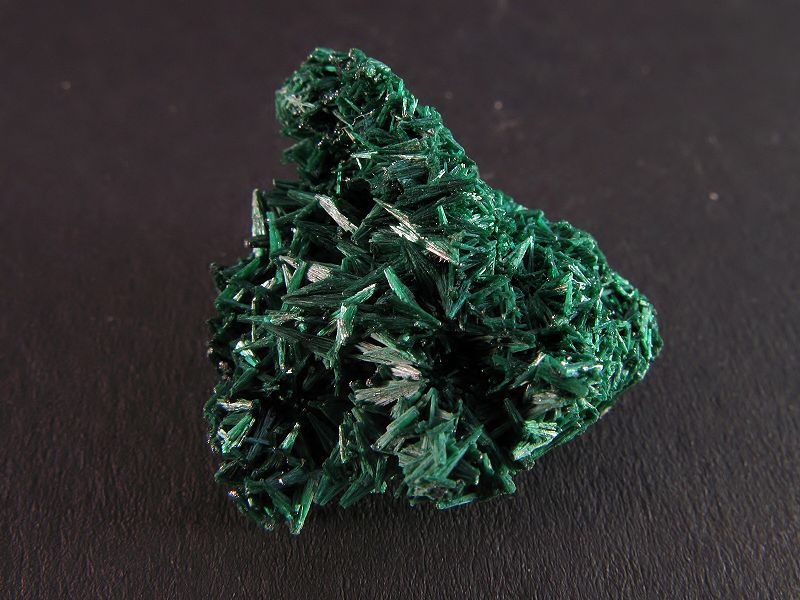
All this  controversy pretty much overshadowed the analysis of the later occupation  at Shanidar.  So I decided to take a look at the book the Soleckis and colleague Anagnostis Agelarakis published in 2004  on the 13,000 -year-old human remains that they excavated. Sure enough,  there was the reference to a copper mineral bead or pendant that likely came from the burial of an adult female.  “The specimen,” wrote the authors,  “was bright green in color,  with a kind of scaly coating on its surface.”

Metallurgical studies show that the bead was made from the mineral malachite and that it contained a high amount of copper.   Moreover,  the authors searched for the source of the copper.  The closest known source was in Anatolia,  some 400 kilometers away from Shanidar– a very long trek away.   But here is the detail that I liked best from the archaeologists’ description.   The bead,  they said, “seemed to have been much worn.”

One can only imagine how much a long-ago woman prized this pretty,  sparkly bead that was so unlike the  plain-jane shell and stone ornaments that others wore.   And it is truly fascinating to think that the world of metal that we live in today may well have begun with a gleam at someone’s throat.

The Streets of Pompeii, Google Style

Image courtesy Wikimedia Commons

Over the past few months,  I have developed very mixed feelings about the internet giant Google.  I hate to see how Google is draining the life out of the newspaper industry,  slurping up all the advertising dollars that once paid for investigative journalism,  foreign bureaus, and very fat papers.  All that has largely fallen by the way for many newspapers,  who are now firmly focussed on survival.

But having said that,  I can see  that someone very high up the food chain at Google is passionate about archaeology.  On November 25th,  I wrote about the 3-D laser scanning project that Google is funding at the Iraq National Museum.  The intent is to bring the treasures of Mesopotamia and other ancient civilizations from the region to scholars around the world.  It’s a wonderful plan.

Now Google has done something else that I really like.  It  has just posted a Street View of Pompeii,  and it’s very, very cool.   You are free to navigate the narrow stony streets of the ancient city at your desk,  stopping to take a gawk at the market stalls and a spin around the forum.  And all on a beautiful,  blue-skied day in southern Italy.

Smallpox Blankets

Over the years,  I have come across numerous references to an insidious  form of germ warfare that some Europeans  employed to defeat Native Americans:  smallpox blankets.  Historians suggest that the practice may have begun as early as the 1530s,  when  Spanish conquistador Francesco Pizarro handed out bedding of smallpox victims to the Inca inhabitants of Peru,  believing that the “miasma”  that caused the disease still clung to the fabric.

One of the most clearly documented conspiracies to employ this weapon comes from the letters and papers of Lord Jeffery Amherst,  the British commander-in-chief for America in 1763.  His hardliner policies against Native Americans in the Great Lakes region had sparked  Pontiac, the chief  of the Ottawa tribe,  to rise up against the British troops.   Amherst wanted victory at any cost.  To defeat the tribes,  he approved the use of smallpox blankets to,  as he said,  “Extirpate this Execrable Race.”

Some historians have questioned whether smallpox can indeed be spread from blankets. But some studies clearly suggest that it can.  In Vectors of Death: The Archaeology of European Contact,  University of New Mexico anthropologist Ann Ramenofsky notes that “although the virus is most frequently transmitted through droplet infection, it can survive a number of years outside human hosts in a dried state.”

All this comes to mind thanks to a fascinating recent post on the Northwest Coast Archaeology blog.  There you will find a partial transcript of an interview that CBC radio interviewer Imbert Orchard conducted in 1969 with Solomon Wilson,  a Haida elder from Maude Island Village on Haida Gwaii  in northern British Columbia.   In this interview,  Mr. Wilson recounts a story he had heard from an elder about smallpox blankets and the spread of disease on the Northwest Coast.   It’s definitely worth checking out.

Who Discovered Australia?

An Australian newspaper carried a fascinating story yesterday  of a mystery shipwreck,  a team of  nautical archaeologists,  and a ocean-going expedition that may end up rewriting a crucial chapter in Australian history.   According to the Sydney Morning Herald,  a team of archaeologists led by Kieran Hosty, a curator at the Australian National Maritime Museum, sailed this morning for Wreck Reef in search of debris from a ship that may have carried American whalers to Australia before James Cook claimed the continent for Great Britain.

Very quickly,  here’s the (slender) evidence.  In 1803,  more than 30 years after James Cook sailed the Australian coast,  a British sloop under the command of  Lieutenant Robert Fowler   slammed at night into an uncharted reef  some 700 miles north of Sydney.   Fowler remained aboard,  but some of the crew explored the sandy reef.  They discovered to their amazement pieces of wooden nautical wreckage.   They later reported that the debris likely came from the stern of large 40- ton ship and that it had been there for a long time.

The crew must have been sopping wet and cold,  because they built a roaring fire with the ship’s timber,  thereby disposing of the prime evidence.  But the Australian archaeologists hope to find other clues on the reef.  Hosty himself thinks its unlikely that the wreckage came from a Dutch  or British ship.  The Dutch sailed further north and British maritime records make no mention of such a shipwreck from the area during this period.  So Hosty now suspects American whalers,  who did sail west to South Pacific waters in search of prey.

I will be following this story with great  interest.  Nautical archaeology is exceptionally expensive,  which is why serious researchers  encounter real difficulties  raising funds to conduct important underwater exploration. (We mainly see newspaper reports of finds made by treasure hunters looking for gold and silver).  And this is an inherently fascinating story.

But I would like to point out that the newspaper headlines miss a critical point.  While James Cook may have claimed Australia for Great Britain,  the ancestors of the Australia’s indigenous people landed on the shores of the continent some 50,000 years earlier.   To get there from mainland Asia,  they crossed at least 10 ocean straits:  one of these crossings was  greater than 44 miles. As Jon Erlandson, an archaeologist at the University of Oregon and one of the world’s experts on coastal archaeology once told me,  it would have been “a real exercise to get across, and the magnitude of that is illustrated by the fact that, before anatomically modern humans make the leap, no large-bodied animal ever gets all the way across.”

I wish  the Australian team the best of luck in their search for the mystery wreck.  But I sure would like to see  more researchers turn their attention to the real discovery of the Australian continent.

The Architecture of Quarantine

Image courtesy of Richard Nickel Jr/The Kingston Lounge

I recently came across a series of remarkable photographs that have given me pause for serious thought. The images are the work of a guerilla preservationist and urban archaeologist, Richard Nickel Jr., and they capture in haunting detail the current state of a place once known as the Georgia Lunatic Asylum in Milledgeville,  Georgia. What struck me immediately was how much these institutional corridors and claustrophobic rooms resembled the architecture I had seen at Dachau  concentration camp in Germany.

Dachau was the first concentration camp that the Nazi government built in Germany,  and it was constructed to isolate those who could not,  according to a German government press release issued on March 21, 1933,  be housed “in normal state prisons.”   Moreover,  its prisoners could not be released back into the general population because,  and again I’m quoting here from the 1933 press release, “they continue to agitate and create unrest when released.”  In other words,  Dachau was designed as a quarantine facility.

And who needed such quarantining?  Adolf Hitler had a very specific population in mind.  In Mein Kampf,  he likened a Jewish person to a type of germ–“a noxious bacillus [that] keeps spreading as soon as a favorable medium invites him.   And the effect of his existence is also like that of spongers; wherever he appears,  the host people dies out after a shorter or longer period of time.”   This hideous racism led directly to the death of six million European Jews.

Facilities such as the Georgia Lunatic Asylum were also clearly designed as places of quarantine,  isolating people with a wide range mental health issues (including the emotional trauma that resulted from sexual abuse and incest) from the general population. And many of the  inmates in these facilities perished far from the public eye.    Some historians suggest that 30,000 people lie buried today at the old Georgia  asylum,  an astonishing figure in my view.   This cemetery is,  according to one paper I read, the largest graveyard  in the world for people with mental issues.

How did so many people come to die in this institution?  Some historians cite rampant epidemics of typhoid and other infectious diseases.  This is may well be true.   But I personally think this is a tragic history that needs further exploring.

For further information on the history of Dachau,  see Barbara Distel and Ruth Jakusch (ed.), Concentration Camp Dachau 1933-1945 (Comite International de Dachau, Brussels: Munich, 1978.)

Dogs for the Dead

Six years ago,  the  Department of Transportation in Washington State stumbled upon a huge, unforeseen problem on the Port Angeles waterfront.  The department was in the midst of constructing a major new dry dock in the city when its workers suddenly began turning up ancient human bone.  Subsequent  investigations by archaeologists, historians, and elders of the Lower Elwha tribe revealed that a Klallam village known as Tse-whit-zen once stood on part of the prop0sed dry-dock site.

But here was the real sticking point.  The site also contained a major burial ground brimming with Klallam  graves:  nearly 335 people had been laid to rest there.   Moreover,  some had clearly perished between A.D. 1780 and 1800,  when diseases such as smallpox,  measles and influenza carried by Spanish mariners  swept through the region for the first time,  decimating Native American villages.  As David Rice,  a senior archaeologist with the U.S. Army Corps of Engineers,  later told The Seattle Times,  a number of the graves contained more than one skeleton and bore signs of  rare forms of ritual treatment, “which would be a spiritual attempt at trying to stop this event.”

In the end,  the Department of Transportation did the right thing.  It decided to abandon construction of the dry dock,  after sinking nearly $60 million into the project.  But the department clearly learned a crucial lesson from the disaster,  and now it’s trying out a very new approach to its archaeological surveys of proposed development sites along the Port Angeles waterfront.  It has brought in dogs–not just the garden-variety Fido, but four animals trained at the Institute for  Canine Forensics in Woodside,  California.  These are corpse-sniffing dogs.

This was the first I had heard of such canines being used to detect human remains in archaeological sites.  But I think they could potentially save developers,  archaeologists and Native Americans  a whole world of grief.  According to the staff at the Institute for Canine Forensics, dogs can smell human remains that are buried as much as nine feet below the surface.  And they can detect remains as old as 2000 years.  “Human remains have a scent that never,  ever goes away,  especially a bone,  even after it dries out,” one of the institute’s staff members told The Peninsula Daily News.

As the owner of a Labrador retriever,  I’ve witnessed time and again the astonishing olfactory prowess of dogs,  and I don’t doubt they could be trained to sniff out very ancient remains.   If the Port Angeles project pans out–and I can’t imagine why it won’t– I  think bringing in such trained dogs should become a standard procedure when North American archaeologists are surveying proposed development sites for possible ancient Native American cemeteries.

Galileo: Saint or Scientist?

As some readers may know,  I write a regular month-end blog for Archaeology magazine’s website (last Friday of the month to be exact.)  Today I  posted on the recent rediscovery in Italy of two mummified fingers belonging to Galileo Galilei,  the first man to gaze at the night skies through a telescope.   I think this seemingly freakish find in Italy tells us an awful lot about how Galileo’s admirers viewed the persecuted scientist after his death.  Indeed,  I think they saw him as a saintly martyr.

To read more about this,   please visit my blog post at Archaeology magazine.

Definitely Not Space Junk

Image Credit: NASA/LOIRP

In an old, abandoned McDonald’s Restaurant at NASA’s Ames Research Center in California,  a group of space buffs are patching together and preserving a vital artifact from NASA’s glorious past:  the FR-900 Tape Drive. Only a NASA engineer,  I’m afraid, could have given such a critical piece of our collective history such a mundane and boring name.  I say this because the FR-900 Tape Drive is the only piece of equipment on earth that can play back the very first close-up images from space that humans took of the moon. These were shot by the NASA’s Lunar Orbiter spacecraft back in 1966 .

In the 1980s,  NASA made a stunningly short-sighted bureaucratic error.   It decided to give away all four of its FR-900 Tape Drives as government surplus to the first person who would cart them off,  forgetting, it seems, that these were the only devices capable of playing back the footage that its Lunar Orbiters took in 1966 and 1967.  One of the Orbiter photos in particular, a breath-taking close-up of the lunar surface,  was described at the time as the “picture of the century.”

Fortunately for all of us,  someone realized that NASA was blowing it.  Nancy Evans,  the co-founder of the NASA Planetary Data System agreed to haul off the machines,  each of which weighed 1000 pounds, and she stored them in a barn in Sun Valley for several decades.  She desperately wanted to raise funds to digitize the images,  and in 2007,  she found two partners–Dennis Wingo at Skycorp Inc and Keith Cowling at Spaceref Interactive Inc.

Together,  the Lunar Orbiter Image Recovery Project team has patched together two of the tape drives and is now in the midst of digitizing some 1984  images in the old McDonald’s restaurant that they’ve taken over.  Moreover,  NASA has now recognized the value of what it nearly threw away.   NASA researchers plan to compare the images from the 1960s with new photos taken of the moon by the next high lunar probe to be launched next spring.

I think what happened to the  FR-900 Tape Drive is a superb cautionary tale.  We now store immense amounts of data on very ephemeral technology:  DVDs,  computer hard-drives and  internet servers.   We need to be thinking now very long and hard about how to preserve this for the future.