Category Archives: Archaeology

Soma, Ephedra and Journeys to the Next World

For the last few days  I have been reading a superb book  about a harrowing journey that 26 undocumented Mexican migrants took  in May 2001 across the Sonora Desert in hopes of reaching Arizona,  and last night it got me thinking, strangely enough,  about soma,  an ancient intoxicating ritual drink mentioned frequently in the Vedas and other sacred texts in Iran.  What’s the connection?  Well,  bear with me.  I think you’ll find this interesting.

The book in question is Luis Alberto Urrea’s The Devil’s Highway,  and it’s a riveting account of the perils that this ill-prepared group of Mexican men and boys faced on their lethal trek through the Arizona desert.  As Urrea points out, many of the guides who accompany such parties into the desert insist that their charges pop fistfuls of ephedra-based diet pills.  The pills,  says Urrea are  a “chemical prod to speed up their walkers….A dose of eight pills at a time really gets them hustling. ”

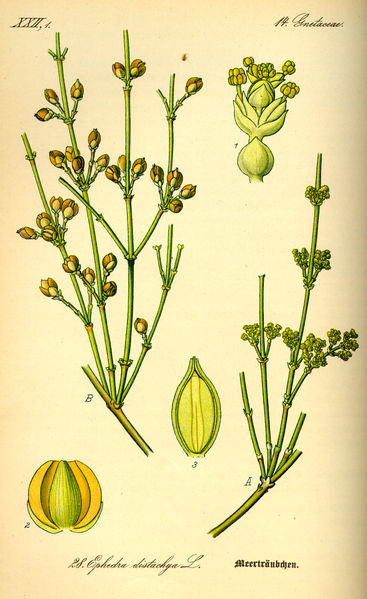
The mention of ephedra really caught my attention.  There are several species in the genus Ephedra,  but they are all unprepossessing, shrubby,  desert-loving plants and several species contain an important stimulant– ephedrine–that produces an adrenaline-like rush in strong doses, and,  in some reported cases, a state of hallucination.

I have been reading a lot in recent weeks about ephedra,  for these plants are found in lavish quantities in the 4000-year-old  graves of Bronze-Age mummies  in the deserts of China’s remote Tarim Basin. As some of you will know,  the Tarim Basin mummies are very famous and controversial,  largely because they are  European in appearance and in the technology they possessed.  (Think plaid woolen clothes.)  As such,  they clearly indicate contact between East and West far earlier than previously believed.

Now here’s the thing.  The fact that archaeologists have uncovered so much ephedra in these graves suggests that it served a very important ritual purpose,  most likely to spur on the spirit of the deceased as it took the long,  dangerous  journey to the next world.

Could the Bronze-Age inhabitants of the Tarim Basin have brought knowledge of ephedra from lands to the west,  such as Iran?  And could ephedra have been one of the plants used to brew soma,  the sacred drink that ancient priests and others imbibed in order to journey to the other world?

Two American researchers,  David Stophlet Flattery and Martin Schwarz,  lay out in minute detail the available scientific evidence for soma in their 1989 book,  Haoma and Harmaline:  The Botanical Identity of the Indo-Iranian Sacred Hallocinogen.  Researchers have long debated possible  ingredients.   But after detailed study,  Flattery and Schwarz concluded that ephedra was one of the key ingredients in the fabled drink.

There are dissenters and doubters of course.   But I think there is something very poignant here.  Illegal Mexican migrants swallow ephedrine pills by the handful today in order to get to a place they think of as the promised land.   But the ephedrine does them no good at all.

Each year, the American border patrol finds hundreds of their bodies lying out in desert.

Lovesick in Pompeii

In honor of the patron saint of romances, St. Valentine,   whose day rapidly approaches,  I thought I’d bring you something very different today–the expressions of love carved upon the walls of Pompeii some 2000 years ago.   This proved to be a little trickier than you might expect at first blush,  for many of the Pompeiian inscriptions are wonderfully raunchy.  The Romans really loved sex and weren’t at all bashful about publicizing their talents in the sack.    So  I had to be a little  selective.

First a word about where I found these wonderful translations. The Italian archaeologist and epigrapher Antonio Varone,  who works in an office building tucked away on the grounds of  Pompeii,  has written a superb book on the inscriptions:  Erotica Pompeiana:  Love Inscriptions on the Walls of Pompeii.   While nearly everyone who visits the ancient resort town notices all kinds of  graffiti scratched on the stone of villas and public buildings, very few possess sufficient knowledge of the  Latin language or Roman culture  to decipher the inscriptions.  Thank you Antonio Varone for opening our eyes.

Ok,  bring on the inscriptions.  First the lovesick:

“Vibius Restitutus slept here alone,  longing for his Urbana.”

“Girl,  you look lovely to Ceius and many others.”

Next, the tender:

“So may you forever flourish, Sabina; may you acquire beauty and stay a girl for a long time.”

The jealous:

Who is it that spends the night with you in happy sleep?  Would that it were me.  I would be many times happier.

The  wry:

“Warmest regards from Puddle to her Fishlet.”

The angry:

“Virgula to her Tertius:  you are loathsome.”

“Erotarin, you jealous old fool.”

The boastful:

“No one’s a real man unless he’s loved a woman while still a boy.”

“Restitutus has often seduced many girls.”

The feminist version:

“Euplia was here with thousands of good-looking men.”

The contented:

“I would not sell my husband…for any price…”

The proud  new parents:

“Cornelius Sabinus has been born.”

What I love most about these inscriptions is their immediacy.  I feel as if I know these people,  as if for a moment or two,  I can share their thoughts across the great dark chasm of time.

Another Step Closer to Waking the Dead

This has been quite a week for ancient DNA stories.  First, the feature article in Archaeology magazine about the possibility of Neanderthal cloning.  And yesterday,  a research paper in Nature reporting the success of an international team in reconstructing the ancient genome of a 4000-year-old man from northwestern Greenland.

The latter project clearly takes us one step closer towards the ability to clone a Neanderthal,  the subject of my last two posts.   But today,  I’d to focus on the new research from Greenland and what I think is important about it.

The team, led by Eske Willerslev,  a very, very  media-savvy researcher at the University of Copenhagen (whose work I have posted on before), obtained its ancient DNA from a tuft of human hair  excavated by an archaeological team in 1986 from a site in northwestern Greenland.  Willerslev and his colleagues make a strong claim that they have ruled out modern contamination.

The archaeologist who excavated the hair has gone on record stating in the 87 pages of supplementary material posted by  Nature that none of the ethnic Greenlanders on his team touched the sample.   He also affirms that no one who was likely of Asian descent handled the hair later during its storage in the museum.

So the team does indeed seem to be working with an uncontaminated ancient sample.  And Willerslev–an expert on ancient DNA–and his Ph.D. student Morten Rasmussen report that the team has reconstructed 80 percent of the nuclear genome.  Based on this,  the team has learned a number of things.

Number one,  the hair belonged to a man who descended from northern-eastern Siberians who migrated to the New World as early as 6400 years ago.  Number two,  the individual in question had blood type A+, brown eyes,  dark skin,  a predisposition to baldness, a genetic adaptation to polar cold,  and other identifiable traits.

Archaeologists already knew, however,  from decades of painstaking study of artifacts that the early Greenlanders descended from northern Asian migrants.   No surprises there.  What is new,  and I think very exciting,  are all the  details of appearance and physiology that have come to light about this particular  individual– gleaned from just a few hairs.

Archaeology has never been very good at getting down to the level of the individual, particularly in that vast expanse of time we call prehistory.   Excavations of  house floors,  middens,  and shell mounds supply a lot of information on families,  communities and populations.   But they rarely say much if anything about individuals.  And in places like North America,  archaeologists try very hard now to avoid digging human remains–a major source of information about individuals–out of respect for Native American beliefs.

So this new ability to glean a lot of information about an individual from a human hair is bound to come in extremely handy,  and I applaud the Danish team for their success.   But its clear to me that such techniques are yet another worrying step along the road to cloning an ancient human or an ancient hominin.

The Danish led team is trying to calm our fears.  “The genome we’ve reconstructed is no Frankstein’s monster,”  team member Rasmussen told EurekAlert!.  “It’s more like we’ve got the blueprints for a house, but we don’t know how to build it.”

For how long,  I wonder.  How long.

Reconstruction/drawing of Inuk by Nuka Godfredtsen.

Politics, Science and the Cloning of Neanderthals

As some of you will know,  I posted yesterday on the ethics of cloning a Neanderthal,  a subject I have been thinking about after reading an article Zach Zorich wrote for Archaeology magazine. Today Zach left a thoughtful response in the comments section of that post,  raising a number of key points.  I’d like to reply.

But first let me briefly summarize  Zach’s remarks. He notes that all the researchers he interviewed for the piece are well aware of the ethical dilemmas of such cloning and that each had given serious thought to these matters–even though such clones are clearly somewhere off in the future.

Then Zach took exception to the comparison I made between the science of creating a Neanderthal clone and Stalin’s desire to fabricate an army of “humanzees”,  human-chimpanzee hybrids.   As Zach points out, “this isn’t some mad scientist’s scenario for world domination.”  Cloning research, he points out, is part and parcel of a larger picture of legitimate medical research,  and any heavy-handed legislation to prevent Neanderthal cloning could wreak havoc with projects designed to extend and protect human life.

I see Zach’s points here, and I share his concerns about heavy-handed legislation.  I’d hate to see a law block an entire line of desperately needed medical research.  But having said that,  I still can’t shake off my anxiety about what could happen further down the road if and when science is indeed capable of cloning a Neanderthal.

Even well-meaning scientists, after all,  are unable to foresee all the consequences of their research,  as some have discovered to their rue.   In the 1960s,  for example, Norwegian researchers developed a new and very lucrative technology for ocean net-pen farming of Atlantic salmon.  So great were the profit margins that a bedazzled Canadian government agreed to permit the same technology–with the same fish–on the British Columbia coast.  Large corporations began farming Atlantic salmon in pens off the British Columbia coast in 1984, leading to the escape of tens of thousands of these alien fish into the  Pacific Ocean.  Today Atlantic salmon gobble up wild food and threaten native salmon species.

So even when guided by the best of all possible intentions,  scientists can create futures they never envisioned.  And it seems to me that when the stakes include the creation of another of our close human relatives that we need to exercise extra special care.  I think that means taking  into account worse -case scenarios, even one as dire as the intentional creation of Neanderthal clones by a malevolent political regime for the purpose of slave labor.

As Zach notes in his comments (and  I should mention in the interests of full disclosure that I know Zach and that he is my editor at Archaeology), my worst-case scenarios do indeed draw on the research I did for my book on Hitler’s archaeologists.  In fact, one of the things that struck me most forcibly during my four years of research and writing on the book was how terribly susceptible science is to political influence.

Most scientists need laboratories,  expensive research equipment,  and academic appointments  in order to pursue their research.  Corrupt regimes know this and they reward pliable scientists with prestigious jobs and ample research funds.  Conversely, they weed out their opponents from universities and cut off their research funding.  In Nazi Germany,  these simple strategies convinced many scientists to pursue lines of state-approved racial research that they would probably have never considered otherwise.   It could certainly happen again.

All this is to say I’m very uneasy with where this cloning research might lead us in the years to come.  I’d like to see legislators at the UN draw a line in the sand.  Cloning research for medical purposes is an important pursuit.  I’m all in favor of it.   But we should never allow cloning experiments to create Neanderthals.


Why We Should Worry about Neanderthal Clones

Should we clone Neanderthals?  That’s the provocative question that science writer and editor Zach Zorich poses in the forthcoming issue of Archaeology,  hitting the news stand on February 15th.  I received an advance copy late last week and read Zorich’s article this weekend. I’ve been thinking about this question ever since, and already I have arrived at my own  answer.  No.  No.  NO.

First of all,  I should point out that this is not a pie-in-the-sky question.  Zorich interviewed an impressive A-list of researchers–including geneticists who are sequencing the Neanderthal genome and leading paleoanthropologists who study ancient hominins–and some clearly believe that a cloned Neanderthal awaits us somewhere down the line.

So it’s not too early to begin thinking and debating about the ethics of cloning one of our hominin kin.  While some researchers champion the idea out of pure scientific curiosity and the desire to learn more about an extinct hominin,  I think it’s a terrible idea.  I simply don’t trust my fellow Homo sapiens sapiens to treat another hominin with kindness and respect.  Our track record with other primates, for example,  is appalling–using chimpanzees for circus shows and laboratory experimentation, hunting gorillas for meat,  and killing orangutan mothers  in order to sell their babies as pets.

And here’s something else that worries me about a Neanderthal clone.  In the 1920s, the Soviet leader  Josef  Stalin ordered the researcher who perfected the technique of artificial insemination,  Ilya Ivanov,  to create a “living war machine. ”  Ivanov’s brief, as American writer Charles Siebert reports  in his remarkable book, The Wachula Woods Accord,  was to artificially inseminate chimpanzees with human sperm to create a new hybrid.

Stalin dreamed of a large,  invincible Red Army and a vast slave workforce to carry out his Five Year Plans.  He thought a chimp-human hybrid would serve admirably. According to Russian newspapers,  Stalin told Ivanov “I want a new invincible human being insensitive to pain,  resistant and indifferent about the quality of food they eat.”

Ivanov failed miserably to produce such chimp-human hybrid, though he certainly tried.   In 1930s,  the biologist fell from political grace and was exiled to Kazakhstan in one of the many purges of the time.

All this strikes me as an important cautionary tale.   What if one of the world’s dictators  got it into his head to clone Neanderthals as slave laborers or a new kind of soldier, one physically stronger than modern humans?   It sounds far fetched,  I know.  But I don’t think we can blithely ignore the lessons of history.

Fueling the New Chinese Mania For Antiques

I can’t believe how badly the New York Times missed the point this morning in its article on the newly red-hot antiquities trade in China.   Journalist Dan Levin reports on the growing mania among  middle class buyers in Beijing for Chinese antiquities, extolling their newfound passion for ” Ming Dynasty porcelain vases,  19th century hardwood furniture and even early 20th century calligraphy ink pots.”  Such antiquities,  Levin explains,  “have become popular status symbols for an emerging middle class eager to display its new wealth and cultural knowledge.”

Too bad Levin didn’t ask a few  hard questions about exactly where all these Chinese antiquities  are coming from.  If he had, he might have come away with a very different impression.  While researching a new story for Archaeology magazine,  I recently discussed with Victor Mair,  a Sinologist at the University of Pennsylvania in Philadelphia, and one of the world’s leading experts on the archaeology of Xinjiang province,   this very issue.

I had noticed in Mair’s  articles that many of the most important Bronze Age and Iron Age sites in Xinjiang–sites that have yielded European-looking mummies and western grave goods and that are now revolutionizing our understanding of Central Asian  history–had been badly looted.  In fact,   looting in Xinjiang has become so serious that Chinese archaeologists are constantly forced to excavate entire cemeteries just to salvage and protect some of the finds.

I asked Mair what on earth was going on.  The Xinjiang sites, after all,  are in the midst of a huge and very barren desert–one of the bleakest and most remote places on earth. Mair explained to me that Chinese looters have become very sophisticated.  They journey into the desert equipped with GPS  and specifically target the ancient cemeteries there. The devastation is enormous,  Mair explained,  with mummified human body parts strewn everywhere.  “They just take the bodies,  the heads, the coffins and throw them out on the ground,” he said.  “They are looking for gold or they are looking for something that is obviously a nice artwork.”

Most looters then sell their finds to middle men in Hong Kong, individuals who don’t ask any questions.  “You can go down to the antiquities market street there,” said Mair, “and you can find unbelievable things, precious materials or precious objects from all over China being sold there.  So Hong Kong is like a  door for selling.”

To me,  this is the real story behind the newfound enthusiasm for antiquities in China. And there is a terrible irony here.   During the Cultural Revolution,  Mao Zedong ordered the destruction of  “old culture,”  officially condoning the looting of old cemeteries  and destroying antiquities.  Now the pendulum has swung wildly in the other direction,  as the Chinese middle class celebrates  its ancient culture.  But the change in attitude has only led to further destruction of the archaeological record.

Museum Curios or Objects of Spiritual Healing?

Two days ago,  I suggested that the Vancouver Museum seriously consider repatriating a petroglyph-covered boulder in its collections to the tribal group in whose territory it was found.  The art on the boulder appears to be deteriorating badly in the museum courtyard as moss and water erode the stone,  obliterating figures that were clear as a bell in the 1930s.  I argued that repatriation would be a good solution to this problem,  for I believe that tribal group in question would have a much greater interest in taking care of the art.

But there’s also a moral argument to be made here.  I don’t think that national, provincial or city museums are the right places for objects of great spiritual importance to aboriginal peoples,  objects that still have a tremendous meaning today. These items, in my opinion,  really need to go back to the tribal group from which they came.   Imagine the outcry,  for example,  if an Egyptian museum held part of the manger of Christ in its collections and would not return it to the Vatican on request?

My views on this matter were strongly shaped by an experience I had while I was working for what is now the Royal Museum of Alberta back in the 1970s.  At the time, the museum held a collection of sacred medicine bundles once owned by healers and spiritual leaders in the Blackfoot Confederacy,  the Niitsitapi.

The museum bought the bundles back in a time when residential schools and other modern ills had badly eroded the traditional culture of the Niitsitapi.   But in the 1970s,  a few people in these tribes were actively reviving traditional spiritual practices.  They wanted their bundles back, because these sacred objects were absolutely essential to age-old spiritual practices.  The museum, however,  stubbornly refused to part with them.

Finally,  however,  four members of the Kainai Nation (part of the Niitsitapi) arrived at the museum one spring day and asked if they could take the Longtime Medicine Pipe Bundle  outdoors for prayer,  as was tradition.  As a young research assistant,  I watched them carry the bundle out past the security cameras and guards.  Outside, they walked in a procession around the museum,  with the museum director and a few other  staff members following.

As they passed the parking lot,   the  Kainai delegation broke into a run toward a waiting pickup truck.  They swiftly clambered in with the bundle  and drove away.  As I later learned,  one member of the delegation had dreamt a few weeks earlier that he could spirit away the bundle from the museum:  today the Kainai talk about how this man cast a charm over the curators.

Many of the Kainai have now returned to their traditional spiritual practices,  and I have heard that the bundle is a very cherished part of those practices.    Clearly, the museum should  have restored the bundle to the Kainai when they asked for it.

I have often heard aboriginal people talk about the sacredness of the rock art.  Isn’t it time that  museums think about giving it back to the people who rightfully own it?

P.S. In You interested in healing and ayahuasca retreats at www.spiritplantjourneys.com.

Somebody Stop Mel Gibson, Please

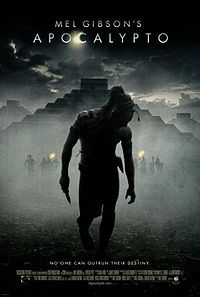
Oh, no.  Not again!  Yahoo News is reporting that Mel Gibson is planning yet another of his nightmarish historical blockbusters.  The man who brought us Braveheart andApocalypto is planning to unleash his filmmaker talents yet again on another unsuspecting ancient culture with a reputation for extreme violence–the Vikings.   “I’m going to give it to you real, man,” Gibson reportedly told a Yahoo News writer.  “I want a Viking to scare you.”

Actually what scares me is Gibson.  The man is a menace.  He loves decking out his projects with all the trappings of historical accuracy, while merrily jettisoning any real fidelity to history and truth.   Take Apocalypto,  his ghoulish, blood-spattered epic on the Maya.  His cast all spoke Yucatec Maya like natives.  His Maya nobles and priests wore exquisite costumes and headdresses.  And he even threw in a real honest to goodness environmental crisis that plagued the Classic Maya–the deforestation of Maya lands to provide timber for fueling lime kilns.   (All the lime went into plaster for the buildings.)

But was Apocalypto true in any way to what we know about the Maya? Not by a longshot.  It depicted the Maya almost en masse as ghoulish blood-thirsty club-wielding savages — what Mayan archaeologist David Friedel once wryly described  as “orcs in loinclothes.”    It depicted little if anything of the beauty and richness of Maya art, science, and religion,  pretty much rendering an entire culture into a historical horror show.

Sure it’s entertainment,  and it wouldn’t matter so much except for two things.  One is that his films are huge box-office hits,  seen by millions of people, particularly impressionable teenagers.   And secondly his version of past looks and sounds so historically authentic that many people are conned into believing that they are witnessing something truthful.

And there’s one other aspect that disturbs me.  Gibson is already talking about how he will apply his techniques of verisimilitude to the Vikings.  “I think it’s going to be in English,  an English that would have been spoken back then and Old Norse,” he told the reporter.   “I want to see somebody who I’ve never seen before speaking low, guttural German who scares the living **** out of you.”  Some critics applauded Gibson for filming in foreign languages in The Passion of the Christ and Apocalypto,  but if Gibson was quoted correctly,  I’d say that he sees the act of speaking in such a language as something that will  increase both the fright factor and brutality of scenes.   What kind of a message is that to send to kids?  How about xenophobic.

I know one film that I won’t be rushing out the door to see.

Should We Be Repatriating Rock Art?

My cup of  Starbucks Breakfast Blend wasn’t the only thing steaming this morning as I read today’s post over at Northwest Coast Archaeology.  It seems that the folks at the Vancouver Museum,  whose job it is to carefully and lovingly preserve its collections for future generations,  are allowing a rare treasure from British Columbia’s Fraser River to crumble and flake into oblivion.  The treasure in question is a massive 5-6 ton boulder once blanketed with petroglyphs. According to the museum,  the art-inscribed boulder once lay in the bed of the Fraser River,  and may have marked an ancient salmon harvesting site.

The petroglyphs are in a dire, near-death state.  In sharp contrast to their striking appearance in a 1930s photograph,  you can barely make them out now.   Partially covered with destructive moss,  the animal figures and other inscriptions are literally disappearing before our eyes–vanishing,  one might add,  as surely as the once bountiful runs of  Fraser River salmon are.  I can’t believe that a museum is allowing this to happen.

But it’s all part and parcel of a much, much larger problem.  Most people,  I’m sorry to say, just don’t value or respect,  much less understand,  ancient rock art. They feel no compunction about prying loose a painted or inscribed boulder from the spot where it was created hundreds or even thousands of years earlier and hauling it off to a museum,  archaeological park or even a private garden.  They think rock art is simply about the art itself–the often mysterious figures painted or inscribed on stone.

But rock art is all about place.    It was created in a specific spot that had great meaning to the ancient artist–a spot, for example,  that looked out on a sacred mountain,  a place where fish were abundant or easy to catch,  or a trail head for a mountain pass or trade route.   For me, there  is nothing more wonderful and exhilarating than coming across a panel of  rock art while I am out hiking with friends.  I love,  of course, to study the inscriptions and photograph them,  and think about what they might mean. But even more than that,  I like to reflect and puzzle over the place itself.   Why did the artists choose that mountain cliff  or this boulder on the beach?  Why there? What made it an important place? What was the artist honoring?

By contrast,  nothing makes me sadder than to see a slab of rock art sitting in a museum foyer or archaeological park.  It looks like an orphan to me,  cut off and isolated from everything that once gave it meaning.  It honors no place any longer,  its meaning has been lost,  its beauty and wonder sadly diminished.

I wonder if it isn’t time to start repatriating rock art in museum collections.  Giving it back to First Nations who may still have stories about where it once stood or belonged. Certainly the First Nations would value it more and take better care of it than that Fraser River boulder at the Vancouver Museum.

Today’s photo shows Buffalo Eddy 2 Petroglyphs at Nez Perce National Historic Park.  Photo courtesy of Nez Perce National Historic Park.