Tag Archives: archeology

Pirouetting in the Street over Bronze-Age Wreck

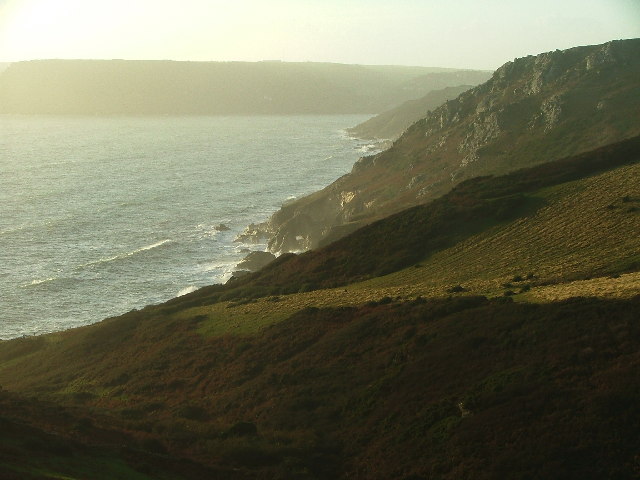
Every once in a while,  an archaeological discovery comes along that makes me feel as if I should leap out of my chair, cartwheel across the room,  and turn pirouettes in the street.  I had one of those days yesterday, when I read the British newspaper accounts of an absolutely stunning underwater discovery off the coast of South Devon.  The  South West Maritime Archaeological Group has discovered the debris field of a Bronze-Age trading vessel,  dating back to 1300 B.C.

This is one of the oldest known shipwrecks in the world.  And what makes me so very, very happy about it is that this immensely important find  is in the hands of serious archaeologists whose sole objective is to advance scientific knowledge –not corporate treasure hunters driven by the bottom line.  Hallelujah!

I have long worried about ancient underwater sites such as this in British waters. The British government,  I am sorry to report,  has failed miserably to step up to the plate when it comes to protecting shipwreckl sites.   Although the Britannia long ruled the waves as a great maritime power,   the British government has so far refused to sign the UNESCO Convention on the Protection of the Underwater Cultural Heritage, a vital piece of  international law protecting prehistoric and historic wrecks from the clutches of treasure hunters.   Thirty-one other nations, however,  have taken the much-needed plunge.

So the discovery of the South Devon site and its astonishing cargo of gold bracelets, rapiers,  sling shots,  tin ingots and the like by devoted avocational underwater archaeologists  is cause for real rejoicing.   Ben Roberts,  an archaeometallurgist and curator at the British Museum, couldn’t be happier.  “The Salcombe site,” he notes,  “is now one of the most important Bronze Age sites currently being investigated in Britain.”

Those interested in learning more about this  amazing discovery can read about the work up until 2006 here,  and can then follow the story to the present here.
Soma, Ephedra and Journeys to the Next World

For the last few days  I have been reading a superb book  about a harrowing journey that 26 undocumented Mexican migrants took  in May 2001 across the Sonora Desert in hopes of reaching Arizona,  and last night it got me thinking, strangely enough,  about soma,  an ancient intoxicating ritual drink mentioned frequently in the Vedas and other sacred texts in Iran.  What’s the connection?  Well,  bear with me.  I think you’ll find this interesting.

The book in question is Luis Alberto Urrea’s The Devil’s Highway,  and it’s a riveting account of the perils that this ill-prepared group of Mexican men and boys faced on their lethal trek through the Arizona desert.  As Urrea points out, many of the guides who accompany such parties into the desert insist that their charges pop fistfuls of ephedra-based diet pills.  The pills,  says Urrea are  a “chemical prod to speed up their walkers….A dose of eight pills at a time really gets them hustling. ”

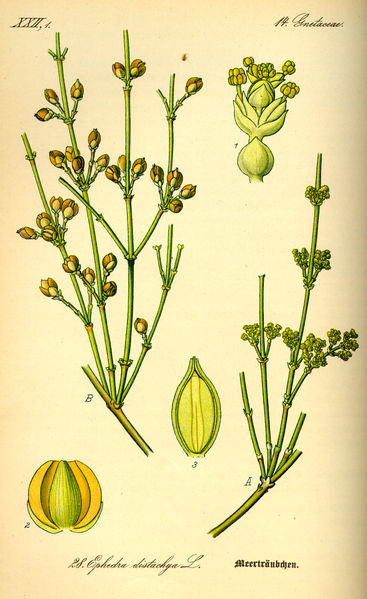
The mention of ephedra really caught my attention.  There are several species in the genus Ephedra,  but they are all unprepossessing, shrubby,  desert-loving plants and several species contain an important stimulant– ephedrine–that produces an adrenaline-like rush in strong doses, and,  in some reported cases, a state of hallucination.

I have been reading a lot in recent weeks about ephedra,  for these plants are found in lavish quantities in the 4000-year-old  graves of Bronze-Age mummies  in the deserts of China’s remote Tarim Basin. As some of you will know,  the Tarim Basin mummies are very famous and controversial,  largely because they are  European in appearance and in the technology they possessed.  (Think plaid woolen clothes.)  As such,  they clearly indicate contact between East and West far earlier than previously believed.

Now here’s the thing.  The fact that archaeologists have uncovered so much ephedra in these graves suggests that it served a very important ritual purpose,  most likely to spur on the spirit of the deceased as it took the long,  dangerous  journey to the next world.

Could the Bronze-Age inhabitants of the Tarim Basin have brought knowledge of ephedra from lands to the west,  such as Iran?  And could ephedra have been one of the plants used to brew soma,  the sacred drink that ancient priests and others imbibed in order to journey to the other world?

Two American researchers,  David Stophlet Flattery and Martin Schwarz,  lay out in minute detail the available scientific evidence for soma in their 1989 book,  Haoma and Harmaline:  The Botanical Identity of the Indo-Iranian Sacred Hallocinogen.  Researchers have long debated possible  ingredients.   But after detailed study,  Flattery and Schwarz concluded that ephedra was one of the key ingredients in the fabled drink.

There are dissenters and doubters of course.   But I think there is something very poignant here.  Illegal Mexican migrants swallow ephedrine pills by the handful today in order to get to a place they think of as the promised land.   But the ephedrine does them no good at all.

Each year, the American border patrol finds hundreds of their bodies lying out in desert.

Lovesick in Pompeii

In honor of the patron saint of romances, St. Valentine,   whose day rapidly approaches,  I thought I’d bring you something very different today–the expressions of love carved upon the walls of Pompeii some 2000 years ago.   This proved to be a little trickier than you might expect at first blush,  for many of the Pompeiian inscriptions are wonderfully raunchy.  The Romans really loved sex and weren’t at all bashful about publicizing their talents in the sack.    So  I had to be a little  selective.

First a word about where I found these wonderful translations. The Italian archaeologist and epigrapher Antonio Varone,  who works in an office building tucked away on the grounds of  Pompeii,  has written a superb book on the inscriptions:  Erotica Pompeiana:  Love Inscriptions on the Walls of Pompeii.   While nearly everyone who visits the ancient resort town notices all kinds of  graffiti scratched on the stone of villas and public buildings, very few possess sufficient knowledge of the  Latin language or Roman culture  to decipher the inscriptions.  Thank you Antonio Varone for opening our eyes.

Ok,  bring on the inscriptions.  First the lovesick:

“Vibius Restitutus slept here alone,  longing for his Urbana.”

“Girl,  you look lovely to Ceius and many others.”

Next, the tender:

“So may you forever flourish, Sabina; may you acquire beauty and stay a girl for a long time.”

The jealous:

Who is it that spends the night with you in happy sleep?  Would that it were me.  I would be many times happier.

The  wry:

“Warmest regards from Puddle to her Fishlet.”

The angry:

“Virgula to her Tertius:  you are loathsome.”

“Erotarin, you jealous old fool.”

The boastful:

“No one’s a real man unless he’s loved a woman while still a boy.”

“Restitutus has often seduced many girls.”

The feminist version:

“Euplia was here with thousands of good-looking men.”

The contented:

“I would not sell my husband…for any price…”

The proud  new parents:

“Cornelius Sabinus has been born.”

What I love most about these inscriptions is their immediacy.  I feel as if I know these people,  as if for a moment or two,  I can share their thoughts across the great dark chasm of time.

Another Step Closer to Waking the Dead

This has been quite a week for ancient DNA stories.  First, the feature article in Archaeology magazine about the possibility of Neanderthal cloning.  And yesterday,  a research paper in Nature reporting the success of an international team in reconstructing the ancient genome of a 4000-year-old man from northwestern Greenland.

The latter project clearly takes us one step closer towards the ability to clone a Neanderthal,  the subject of my last two posts.   But today,  I’d to focus on the new research from Greenland and what I think is important about it.

The team, led by Eske Willerslev,  a very, very  media-savvy researcher at the University of Copenhagen (whose work I have posted on before), obtained its ancient DNA from a tuft of human hair  excavated by an archaeological team in 1986 from a site in northwestern Greenland.  Willerslev and his colleagues make a strong claim that they have ruled out modern contamination.

The archaeologist who excavated the hair has gone on record stating in the 87 pages of supplementary material posted by  Nature that none of the ethnic Greenlanders on his team touched the sample.   He also affirms that no one who was likely of Asian descent handled the hair later during its storage in the museum.

So the team does indeed seem to be working with an uncontaminated ancient sample.  And Willerslev–an expert on ancient DNA–and his Ph.D. student Morten Rasmussen report that the team has reconstructed 80 percent of the nuclear genome.  Based on this,  the team has learned a number of things.

Number one,  the hair belonged to a man who descended from northern-eastern Siberians who migrated to the New World as early as 6400 years ago.  Number two,  the individual in question had blood type A+, brown eyes,  dark skin,  a predisposition to baldness, a genetic adaptation to polar cold,  and other identifiable traits.

Archaeologists already knew, however,  from decades of painstaking study of artifacts that the early Greenlanders descended from northern Asian migrants.   No surprises there.  What is new,  and I think very exciting,  are all the  details of appearance and physiology that have come to light about this particular  individual– gleaned from just a few hairs.

Archaeology has never been very good at getting down to the level of the individual, particularly in that vast expanse of time we call prehistory.   Excavations of  house floors,  middens,  and shell mounds supply a lot of information on families,  communities and populations.   But they rarely say much if anything about individuals.  And in places like North America,  archaeologists try very hard now to avoid digging human remains–a major source of information about individuals–out of respect for Native American beliefs.

So this new ability to glean a lot of information about an individual from a human hair is bound to come in extremely handy,  and I applaud the Danish team for their success.   But its clear to me that such techniques are yet another worrying step along the road to cloning an ancient human or an ancient hominin.

The Danish led team is trying to calm our fears.  “The genome we’ve reconstructed is no Frankstein’s monster,”  team member Rasmussen told EurekAlert!.  “It’s more like we’ve got the blueprints for a house, but we don’t know how to build it.”

For how long,  I wonder.  How long.

Reconstruction/drawing of Inuk by Nuka Godfredtsen.

Fueling the New Chinese Mania For Antiques

I can’t believe how badly the New York Times missed the point this morning in its article on the newly red-hot antiquities trade in China.   Journalist Dan Levin reports on the growing mania among  middle class buyers in Beijing for Chinese antiquities, extolling their newfound passion for ” Ming Dynasty porcelain vases,  19th century hardwood furniture and even early 20th century calligraphy ink pots.”  Such antiquities,  Levin explains,  “have become popular status symbols for an emerging middle class eager to display its new wealth and cultural knowledge.”

Too bad Levin didn’t ask a few  hard questions about exactly where all these Chinese antiquities  are coming from.  If he had, he might have come away with a very different impression.  While researching a new story for Archaeology magazine,  I recently discussed with Victor Mair,  a Sinologist at the University of Pennsylvania in Philadelphia, and one of the world’s leading experts on the archaeology of Xinjiang province,   this very issue.

I had noticed in Mair’s  articles that many of the most important Bronze Age and Iron Age sites in Xinjiang–sites that have yielded European-looking mummies and western grave goods and that are now revolutionizing our understanding of Central Asian  history–had been badly looted.  In fact,   looting in Xinjiang has become so serious that Chinese archaeologists are constantly forced to excavate entire cemeteries just to salvage and protect some of the finds.

I asked Mair what on earth was going on.  The Xinjiang sites, after all,  are in the midst of a huge and very barren desert–one of the bleakest and most remote places on earth. Mair explained to me that Chinese looters have become very sophisticated.  They journey into the desert equipped with GPS  and specifically target the ancient cemeteries there. The devastation is enormous,  Mair explained,  with mummified human body parts strewn everywhere.  “They just take the bodies,  the heads, the coffins and throw them out on the ground,” he said.  “They are looking for gold or they are looking for something that is obviously a nice artwork.”

Most looters then sell their finds to middle men in Hong Kong, individuals who don’t ask any questions.  “You can go down to the antiquities market street there,” said Mair, “and you can find unbelievable things, precious materials or precious objects from all over China being sold there.  So Hong Kong is like a  door for selling.”

To me,  this is the real story behind the newfound enthusiasm for antiquities in China. And there is a terrible irony here.   During the Cultural Revolution,  Mao Zedong ordered the destruction of  “old culture,”  officially condoning the looting of old cemeteries  and destroying antiquities.  Now the pendulum has swung wildly in the other direction,  as the Chinese middle class celebrates  its ancient culture.  But the change in attitude has only led to further destruction of the archaeological record.

Should We Be Repatriating Rock Art?

My cup of  Starbucks Breakfast Blend wasn’t the only thing steaming this morning as I read today’s post over at Northwest Coast Archaeology.  It seems that the folks at the Vancouver Museum,  whose job it is to carefully and lovingly preserve its collections for future generations,  are allowing a rare treasure from British Columbia’s Fraser River to crumble and flake into oblivion.  The treasure in question is a massive 5-6 ton boulder once blanketed with petroglyphs. According to the museum,  the art-inscribed boulder once lay in the bed of the Fraser River,  and may have marked an ancient salmon harvesting site.

The petroglyphs are in a dire, near-death state.  In sharp contrast to their striking appearance in a 1930s photograph,  you can barely make them out now.   Partially covered with destructive moss,  the animal figures and other inscriptions are literally disappearing before our eyes–vanishing,  one might add,  as surely as the once bountiful runs of  Fraser River salmon are.  I can’t believe that a museum is allowing this to happen.

But it’s all part and parcel of a much, much larger problem.  Most people,  I’m sorry to say, just don’t value or respect,  much less understand,  ancient rock art. They feel no compunction about prying loose a painted or inscribed boulder from the spot where it was created hundreds or even thousands of years earlier and hauling it off to a museum,  archaeological park or even a private garden.  They think rock art is simply about the art itself–the often mysterious figures painted or inscribed on stone.

But rock art is all about place.    It was created in a specific spot that had great meaning to the ancient artist–a spot, for example,  that looked out on a sacred mountain,  a place where fish were abundant or easy to catch,  or a trail head for a mountain pass or trade route.   For me, there  is nothing more wonderful and exhilarating than coming across a panel of  rock art while I am out hiking with friends.  I love,  of course, to study the inscriptions and photograph them,  and think about what they might mean. But even more than that,  I like to reflect and puzzle over the place itself.   Why did the artists choose that mountain cliff  or this boulder on the beach?  Why there? What made it an important place? What was the artist honoring?

By contrast,  nothing makes me sadder than to see a slab of rock art sitting in a museum foyer or archaeological park.  It looks like an orphan to me,  cut off and isolated from everything that once gave it meaning.  It honors no place any longer,  its meaning has been lost,  its beauty and wonder sadly diminished.

I wonder if it isn’t time to start repatriating rock art in museum collections.  Giving it back to First Nations who may still have stories about where it once stood or belonged. Certainly the First Nations would value it more and take better care of it than that Fraser River boulder at the Vancouver Museum.

Today’s photo shows Buffalo Eddy 2 Petroglyphs at Nez Perce National Historic Park.  Photo courtesy of Nez Perce National Historic Park.

Jihadist and Young Archaeologist

Did Mohamed Atta,  the man who flew American Airlines Flight 11 into a World Trade Center tower, pay for his  flying lessons by selling looted antiquities? It now looks like a distinct possibility. According to The Art Newspaper,  a senior Italian official has stated publicly on several occasions that Germany’s secret service, BND,  possesses testimony documenting Atta’s attempt to sell looted Afghan artifacts to a German archaeologist in 1999.

Atta, as you may recall, was born into a wealthy Egyptian family and graduated from the University of Cairo in 1990  with a degree in architecture.  After a short stint as an architectural planner in Cairo,  the young Egyptian  moved in 1992 to Germany,  where he enrolled at the Technical University of Hamburg-Harburg.   There Atta studied under Dittmar Machule, an expert on Middle Eastern architecture who was conducting an archaeological excavation at a Bronze-Age site in northern Syria.

So interested did Atta become in archaeology that Machule invited him to visit the Syrian dig in 1994.  The German professor later recalled what happened  in an interview with ABC television.   Atta,  said Machule,   “slept in the tent as we all slept and he was very interested in the excavation.  I explained to him what we are doing, the methods of archaeology, the research and I remember that he wanted to help.”

Five years later,  in 1999,  says Guiseppi Proietti,  secretary general of Italy’s Ministry of Culture, Atta approached a University of Goettingen archaeologist with a business proposition.  He offered to sell the unnamed archaeologist Afghan artifacts,  explaining that he needed the money to pay for flying lessons he wanted to take in the United States.   The archaeologist declined the offer.

How might Atta have obtained these artifacts?  As investigators have now established, Atta became increasingly radicalized during his studies in Germany and disappeared for lengthy periods of time.  During the university’s winter break in 1997, for example, he vanished for three months, and applied on his return for a new passport,  claiming he had lost his–a common strategy that jihadists employed to conceal their travel to a terrorist camp.

With his newfound knowledge of archaeology,  Atta may have spent his spare time in Afghanistan looting remote sites and collecting antiquities.  And it certainly seems possible that he sold the plunder privately or through auction houses  in order to finance the flying lessons that ended in such terrible tragedy.

This is an appalling scenario–European collectors financing one of the worst terrorist attacks in recent memory.   I sure would like to know more about this.

Leonardo da Vinci: Taking His Last Secrets to the Grave

Did you catch the news headlines yesterday about the Italian researchers who hope to open the tomb of Leonardo da Vinci in France in order to reconstruct his face?  They are keen to see whether the Renaissance artist was indulging in his well-known love of riddles when he painted the Mona Lisa.  For years,  some some scholars have hypothesized that the mysterious beauty in the painting was a self-portrait in drag.

My first reaction to this proposed project was to shake my head in disbelief.  Is this really a valid reason to disturb the sleep of the dead, particularly someone so deserving of our respect? Are we so driven by curiosity that we need to rummage through chill church tombs and peer at the bones of the dead in order to answer a question that is on the level of a barroom bet?

And  I was not  reassured when I Googled the team’s spokesperson, Giorgio Gruppioni, a bioanthropologist at the University of Bologna.  In 2009, Gruppioni and several colleagues  reconstructed the face of one of Italy’s greatest poets, Dante Alighieri, using the cranial data that researchers recorded in 1921 when officially identifying Dante’s remains.  And just a few weeks ago,  Gruppioni and colleagues recovered what they hope will be the remains of  the great 17th century Italian painter, Caravaggio.   Once again, the team announced plans to reconstruct Caravaggio’s face.  Gruppioni and his colleagues seem awfully interested in surface appearances.

But the more I thought about it,  the more I began to see a legitimate context for  these projects.  For the past two decades,  several Italian research teams led by pathologists and anthropologists have been prying open Renaissance tombs and reliquaries to gather vital scientific data.  One of the leading researchers in this field, University of Pisa pathologist Gino Fornaciari has spearheaded several of these projects,  exhuming such Renaissance luminaries as Cosimo I de’ Medici,  Ferdinand II of Aragon, and Maria D’Aragona,  one of the greatest beauties of her day.

I have met and talked at length with Fornaciari,  and can attest to his interest in serious science.  And I was really intrigued today when I checked out his recent publications to see what science had learned from all these rude awakenings of the dead.   His papers covered a wide range of subjects–the methods that Renaissance embalmers employed to artificially mummify royalty  in 16th century Europe;  the species of lice that clung to the mummified remains of Ferdinand II (revealing that these parasites plagued even the wealthiest  during the Renaissance); and the human papillomavirus  (HPV) that infected Maria D’Aragona.  The latter study will permit medical researchers to study the evolution of this important virus, a major cause of cervical cancer, perhaps giving them clues to new treatments.

If the team that wants to open Leonardo da Vinci’s grave obtains permission to do so, I strongly suspect that they will make the most of this rare opportunity,   gathering all the relevant samples and data to do key pathological and bioarchaeological studies.  I personally don’t care whether the great artist painted the Mona Lisa in his own image. But I’d love to know more about the health and life of this great Renaissance artist.

Egyptian Mummification–On a Reality Show Coming Your Way

What sensational balderdash is this? A British production company is currently looking for a terminally ill person willing to undergo ancient Egyptian mummification. While some people might welcome immortality Tutankhamen-style,  there’s a huge catch.   The whole stomach-churning procedure will be caught on camera and shown later on high-def television across Britain.  Can you imagine watching anything worse on a 54- inch screen?

Steve Connor, a wonderful journalist at the Independent, broke this story a few weeks ago, and ever since fellow science writer Josie Glausiusz emailed me about it, I’ve been fuming.  In the late 1990s,  I flew down to Chile to attend a major conference of the world’s leading experts on mummies,  and later wrote a book about my experiences.   Two of the experts I met there,  Bob Brier, a senior research fellow at Long Island University, and Ron Wade,  director of the State Anatomy Board in Maryland,  had just completed an important project in experimental archaeology.  The two men had managed to mummify a modern human corpse in the lab by using ancient Egyptian methods recorded in early texts.

In other words,  we know exactly how the Egyptians did it.  Science will not  be gaining anything from this program.   And I have to ask myself how many viewers  in their right minds will want to sit down with their kids and watch a real mummification.   The procedure begins,  for example,  by piercing the subject’s cranial vault.  To do this,  the mortician has to thread a metal tool through one of the nostrils and puncture the ethnoid bone that sits between the eye sockets.  Then the mortician has to either draw or pour out the grey viscous brain matter.  And that’s only for starters.   The embalmers–who will not be skilled at this–will also have to haul out fistfuls of intestines and other internal organs by reaching blindly into  a small incision.  Good luck.

I find it hard enough to write about this.  Imagine watching it, particularly after you have gotten to know the terminally ill person in the opening episode.  That’s the particularly twisted part of the producer’s  plan.  He wants viewers to meet the subject as a living person,  so that they will have an “emotional response” during the mummification process.

The ancient Egyptians had far more sense.   Their morticians set up their workshops on the outskirts of towns,   away from prying eyes,  and they tended to guard their trade secrets very carefully.   I think it’s enough to know these secrets today.  I don’t see any reason at all to parade them ghoulishly in front of a sensation-hungry public.