Monthly Archives: January 2010

Wolves That Hunt Salmon

How smart exactly are wolves? As some readers will know, I posted yesterday on one archaeologist’s investigation of the shadowy origins of dogs, and that led me into a short discussion of wolf behavior. Today, I’d like to share a great wolf anecdote I heard while attending a recent talk in Vancouver given by acclaimed environmental writer Andrew Nikiforuk (an old friend of mine) and conservationist Ian McAllister. While this post strays a little from the customary terrain of this blog–archaeology and history–I hope that you will bear with me.

McAllister has been studying the wolf populations that roam the northern British Columbia coast. Superbly adapted to coastal living, these wolves have devised rather novel ways of hunting. Instead of stalking primarily big game such as deer, these canines have developed a huge appetite for seafood. One of their favorite prey is salmon.

During the great salmon runs, McAllister noted, he has spied dozens of dead salmon at a time lying on the banks of salmon streams–the result of one night’s hunting. The wolves capture the fish, carry them ashore and then neatly, almost surgically, decapitate them, eating only the fat-rich head.

To prove his point, McAllister showed a photo he had taken of one such kill site, littered with the headless bodies of salmon. I found it utterly fascinating. Below you will find a short YouTube video of a wolf hunting a salmon.

The Archaeologist and the Wolf

There’s been a lot of talk around our dinner table lately about a fascinating new book entitled The Philosopher and the Wolf.    Half autobiography, half philosophical meditation, the book explores the intense relationship that University of Miami philosopher Mark Rowlands had with a wolf that he naively adopted as a cub.  As Rowlands recounts it, Brenin the wolf was a superb companion, but as a true pack animal he could not tolerate solitude.

Indeed,  Rowlands could not leave his wolf alone anywhere.  When once he left Brenin in his jeep during a ferry trip,  the frustrated animal began to literally eat his way through the vehicle,   shredding seats and seat belts and gnawing away the roof.  There wasn’t much left of the interior when Brenin was done. So Rowlands learned to take his  wolf with him everywhere,  even into the classroom.

I thought of this anecdote today as I was read an intriguing  news article about the work of archaeologist Jeff Blick.   Blick, who teaches at Georgia College & State University, is an expert on prehistoric dogs.  He has spent much of the past two decades analyzing the skeletons of 112 dogs that he and his colleagues excavated from the Weyanoke site in Virginia.  It is, by all reports,  the largest collection of prehistoric dog skeletons in North America.

Blick, who much prefers cats to dogs in his private life, has learned an awful lot about these 1000-year-old canines.  The dogs were about the size of a modern Shetland sheep dog,  and while some were sacrificed,  at least one was buried at the feet of its owner.   They dined on fish, turkey, and turtle meat,  and they may well have been barkless.  Many of the early Europeans in the Americas commented on the fact that the native dogs didn’t let out barks;  instead they tended to howl like their wolf ancestors.   (And for those of you who have never heard what a wolf sounds like,  please click here.)

Blick is interested in the question of where and how dogs were first domesticated. Some research suggests that eastern Asians were the first to domesticate wolves and that their faithful pets followed them on a long cold trek across Beringia to the New World.  Other research points to an origin in northern Africa.  Blick himself now hypotheses that people in North America and other parts of the world independently domesticated dogs and he is now trying to gather ancient canine DNA to test the idea.

All this of course begs the biggest question of all in my mind.  Why did humans first tame wolves and turn them into dogs?  I’m beginning to think that wolves themselves had at least a small say in the matter.  They didn’t want to be alone.

Wanted: Archaeologists for CSI

A community newspaper in London, England, carried an important article last week with an unusual request. According to the London Daily Advertiser,  a Romanian institute dedicated to the investigation of   Communist crimes in that country has put out a call for archaeologists to volunteer for the excavation of a mass grave in the Apuseni Mountains. According to the institute’s director, historian Marius Oprea, the mass grave in question contains the bodies of five anti-communist resistance fighters, including a pregnant woman, who were all killed by the Romanian secret service during the 1960s.

This sounds like a very worthy project,  and it reminds me of something I often hear from archaeologists–namely that they struggle daily to find a way to make their discipline relevant to students who are not particularly interested in what happened five years ago,  much less five centuries or five millennia ago.   And yet the techniques of archaeological mapping,  excavation and analysis are directly pertinent to crime scene investigation.

One year ago,  I published an article entitled “Witness to Genocide”  in Archaeology Magazine,  about a team of archaeologists and physical anthropologists who excavated several mass graves in Iraq,  at the height of the insurgency.  The team members risked their lives to dig and document the remains of  more than 100 Kurdish women and children who were secretly massacred by Iraqi forces in 1988 and buried at a site known as Muthanna in a remote desert near the Saudi Arabian border.

Michael Trimble,  a civilian archaeologist in the U.S. Army Corps of Engineers,  led the archaeological team.  And on November 30, 2006,  he took the stand as an expert witness in the trial of Saddam Hussein and several of his key supporters,  who were charged with crimes against humanity and genocide of the Kurds.  During four hours of grueling testimony,  Trimble presented the key results of the archaeological and anthropological investigation.   Here’s what happened on the stand (and please forgive me for quoting myself):

“As he spoke, he tried to maintain as much eye contact as he could with the judges. Partway through his presentation, however, he noticed one judge dabbing his eye. Two others soon followed suit. At first Trimble was puzzled, thinking something was wrong. Then he realized what was happening. “My God,” he thought, “they are all crying.”

The team’s meticulous excavation furnished a host of horrific and very telling details that brought the victims of the Muthanna massacre back to life.  And with the benefit of a geographical information system expert,  they reconstructed the crime in detail.  The security forces had literally mowed down the victims–some of whom were infants and very young children–as they stood in a prepared mass grave.  It doesn’t get much more chilling than that.

If this kind of forensic investigation is not a way to make archaeology relevant today,  I really don’t know what is.   Romanian historian Marius Oprea has put out a call for help. I sure hope some archaeologists will answer.

How Early Wooden Armor Defeated Russian Firearms

As regular readers will know,  I’ve been thinking a lot this week about ancient forms of body armor.  I got started on this  subject last weekend, when I read about new research on the cloth armor that Alexander the Great and his army favored.  But a question from reader Dan Hilborn and a very cool post over at Northwest Coast Archaeology (one of my favorite blogs) have led me to the subject of wooden armor, specifically the armor Tlingit men wore into battle against Russian traders  in the late 18th century.

The Russians coveted furs — primarily the sea-otter fur,  which is the thickest and warmest of any mammal on Earth.  By the 18th century,  these traders had pretty much exhausted the sea-otter populations that once flourished in Siberia’s kelp forests, so they sailed further east along the coast of the Bering Sea,  searching for new kelp forests and more sea-otters.  Along the Aleutian Islands, Alaska and eventually northern British Columbia,  they spied abundant sea-otter habitat

Initially,  the Russians traders sailed into Aleut villages,  taking women and children hostages in order to force the men to bring them pelts.  They did not hesitate to murder their captives if things didn’t go their way.   In 1745,  a Russian group slaughtered 15 Aleuts on the island of Attu,  just to strike terror into the hearts of the villagers.  The Aleut people, in turn,  tried to expel these ruthless invaders from their lands, but Russian firearms and Russian diseases took a terrible toll.

Eventually,  the Russians worked their way southward into Tlingit territory.  Like many Northwest Coast peoples,  the Tlingit fished the bountiful rivers and coasts of their territory and hunted sea lions and other sea mammals.  They had a rich, complex culture,  with chiefs,  nobles and even slaves.   To settle grievances with their neighbors,  they embarked on raiding parties from time to time,  outfitting themselves in armor made from the one of the most bountiful materials in their territory:  wood.   Tlingit men carved alder into slats and rods,  then lashed these pieces together to form  sturdy, lightweight armor.

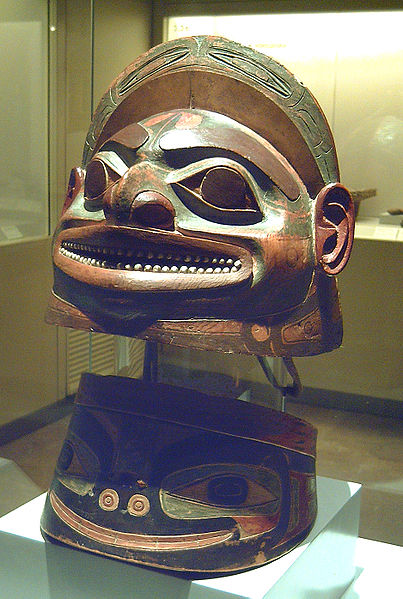
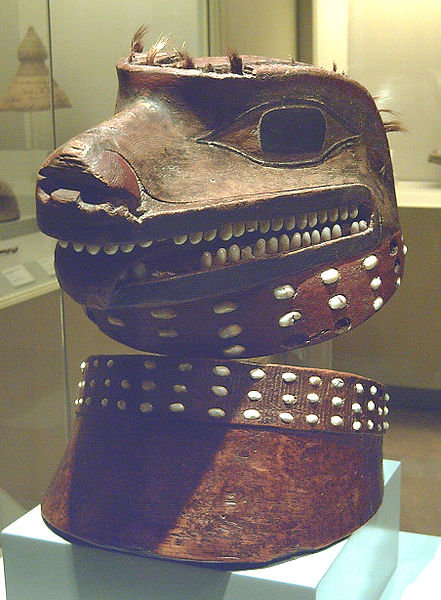
The  Smithsonian Institution holds several really spectacular examples of the traditional Tlingit armor.  I particularly love the Tlingit battle helmet beautifully carved from a very hard spruce burl.  The helmet itself is shaped like a very fierce-looking (and tattooed) man’s head and would have been worn atop the fighter’s head. According to the Smithsonian notes,  “it would have been “impossible to split open with a club.”  (The two images accompanying this blog show other Tlingit armor from the collection of  a Spanish museum.)

But back to my story.  After seeing images of Tlingit war gear,  I began to wonder how effective it was  in battle against the Russians and their firearms.   I knew that the Tlingit had put up a very strong  fight against the Russians, even capturing their settlement,  New Archangel,  on Sitka Island in 1802.  But an account of one battle  in Carl Waldman’s book, Atlas of the North American Indian,   really caught my attention.

In their attack on Russian-led forces in Prince William Sound,  writes Waldman,  the Tlingit  “wore animal masks to protect their faces as well as chest armor of wooden slats lashed together with rawhide strips,  which actually repelled Russian bullets.”  (The italics are mine.)

I would never have  guessed that well-made wooden armor could deflect a bullet.  It looks to me as if we don’t give early armorers nearly enough credit.

Sugar: A Short Bittersweet History

Wealthy Europeans of the Renaissance adored dessert time.  Indeed their cravings for sweet cakes and marzipan, plum pies and mince tarts far outstripped supplies of the chief ingredient—refined sugar.  To keep up with the vast demand and turn fields of  sugar cane into bags of white sugar, European mill owners required timber to fuel their boiling vats: by the early 16th century, sugar masters from Italy to Madeira had all but exhausted the most easily accessible forests.

The first Spanish colonists to land in the Caribbean understood this problem perfectly, and when their quest for gold failed in Jamaica, they turned to sugar in 1515 to make their fortunes.  In Jamaica’s earliest settlement–Sevilla la Neuva–Francisco Garay, a former slave trader and minor member of the Spanish nobility, imported a sugar master,  constructed a large mill to process newly planted sugar cane and forced Jamaica’s indigenous Taino villagers to do all the hard labor.

Simon Fraser University archaeologist Robyn Woodward and her team are now excavating the industrial quarter of Seville la Neuva,  uncovering traces of a tragic history that ended in the decimation of the Taino .   To read more about this new research,   please see my newly posted article on the Smithsonian magazine website.

Replicating the Armor of Alexander the Great

I think that there are few things more delightful and amusing to watch than an adventurous archaeologist in the act of trying replicate ancient drinks, hunting techniques, weapons, or other long vanished technologies. Who knew, for example, how punishingly difficult it was to chew one’s way through dozens of pounds of milled corn to make chicha, the beer of choice for the Inca and other Andean peoples? I had no idea until I began looking into the experiments of Penn State archaeologists Patrick McGovern and Clark Erickson and their associates at Dogfish Head Brewing & Eats.

Yesterday, I found a very intriguing YouTube video of the experiments that University of Wisconsin historian Gregory Aldrete and his student Scott Bartell conducted on linothorax, the ancient linen armor worn by Alexander the Great and his army. I wrote about their research on this remarkable kevlar like gear in my post yesterday, but seeing is really believing. Check this out.

Cloth, a Body Armor of Choice?

I think it’s safe to say that the ancient world is absolutely full of surprises.  While most of us have long envisioned Alexander the Great donning a gleaming bronze cuirass for battle,  new research presented last week at the annual meeting of the Archaeological Institute of America reveals that one of the greatest military generals in history and his soldiers favored a much humbler form of body armor–cloth.

Gregory Aldrete,  a historian at the University of Wisconsin in Green Bay,  and his student Scott Bartell, became interested in Alexander’s armor after collecting more than two dozen different classical descriptions of a type of cloth armor known as linothorax, made of linen.  The Greek historian Plutarch, for example,  describes Alexander’s gear on the day  he headed into the famous Battle of Gaugamela in 331 B.C. and decisively defeated the forces of the  Persian king Darius III. Alexander, says Plutarch,  wore “a breastplate of folded (or doubled) linen.”

Intrigued by this,  the two historians set out to replicate linothorax.  They scrambled to find linen made from hand-harvested and woven flax,  and then painstakingly glued the layers of linen together with two types of glue available in the ancient world –one made of rabbit skins and the other from flax seeds. The two historians then set up a kind of ancient firing range,  shooting arrows and thrusting swords at the linothorax.  “The laminated layers function like an ancient version of modern Kevlar armor,” Aldrete told a reporter from Discovery News, “using the flexibility of the fabric to disperse the force of the  incoming arrow.”

What I find particularly fascinating is the fact that soldiers in both the Old and New World developed cloth armor.  Aztec warriors,  for example,  wore a kind of quilted cloth-armor jacket or tunic known as ichcapuipilli for combat against the Spanish invaders.  This battle gear consisted pieces of unspun cotton sandwiched between two layers of cotton:  the armor measured nearly two fingers in thickness and, according to Ross Hassig’s fine book, Aztec Warfare,  was capable of deflecting both arrowheads and atlatl darts.

Inca soldiers,  too,  wore a form of cloth armor.   The attire couldn’t protect its wearer against cannon fire or Spanish steel swords,  but  it clearly had some advantages.   It was comfortable,  lightweight, and probably very cool in the heat of mid-day.  So some 16th century Spanish soldiers themselves adopted it, wearing cotton armor into battle in the Andes.

Clearly,  there is more to cloth than meets the eye.

The Most Ancient Mariner

When did land-loving humans first trust their fates to simple rafts and begin exploring the world by water?  Most archaeologists would say some 50,000 years ago,  when anatomically modern humans sailed from island southeast Asia to Australia.   But Thomas Strasser, an archaeologist at Providence College in Rhode Island, dropped a bombshell last week at the annual meeting of the Archaeological Institute of America. Strasser reported that he had found several hundred double-edged cutting tools on the island of Crete that dated to at least 130,000 years ago.  Some,  said Strasser,  looked very much like the hand-axes that Homo erectus wielded in Africa 800,000 years ago.

Strasser now proposes that the ancient hominins voyaged out of Africa by primitive boat,  island-hopping from Crete to Europe.  “We’re just going to have to accept that,  as soon as hominids left Africa,  they were long distance seafarers and rapidly spread all over the place,”  Strasser told Science News reporter,  Bruce Bower.

This new evidence sounds immensely intriguing,  and I would certainly like to know much more.  But I think that we are still a long way from seeing Homo erectus as a seafarer.   Other evidence for such primeval ocean voyaging,  after all,  is very thin.   Let me briefly recap.  In 1998,  a team led by Michael Morwood,  an archaeologist at the University of New England in Armidale, Australia,  excavated  stone tools on the island of Flores in Indonesia (the same island that produced the so-called “Hobbit” remains of Homo floresiensis) that dated to some 800,000 years ago.  This was the time period when H. erectus was roaming southeast Asia.

How did the ancient hominin get to Flores?  Morwood himself suggested that they might have held on to logs as simple flotation devices, and kicked their across the narrow strait separating Komodo from Flores.  But a more flamboyant researcher, Robert Bednarik,  an independent scholar who heads The First Mariners project, proposes that H. erectus sailed there by raft.   To demonstrate that such a voyage is indeed possible,  Bednarik and several associates built a bamboo raft with paleolithic stone tools, and then sailed successfully on it from Lombok to the neighboring island of Sunbawa in a ten hour and twenty five minute crossing in rough seas.

So such a voyage is indeed possible in a simple raft.   But most archaeologists working on the subject of coastal migration have been exceedingly reluctant to buy into the idea of seafaring H. erectus.  When I interviewed half a dozen of the world’s leading experts on the subject two years ago while working on an article on ancient seafaring for Discover magazine,  most suggested that that ancient hominins likely floated to Flores accidentally,  after being blown out to sea in a storm.

A major sticking point for many is the cognitive ability of H. erectus.  Many researchers believe that only modern humans possessed the necessary technological creativity to build a raft and the requisite intellectual ability to navigate at sea.   But if Strasser’s new findings are accepted (and you can be sure that people will be looking very carefully at both the stone tools themselves  and at the proposed dates), then it could be a whole new ballgame.    I personally will be following this research with great interest.

Royal Chamber-Pots and Privies

Today, I’m bringing you a small, strange, guilty pleasure. I just stumbled across this delightful video of a very animated British archaeologist showing off the ancient privies of British kings and queens at several royal palaces. (Does anyone know who she is? She’s terrific, but uncredited.) Check out her real delight at finding residues of Tudor urine in a chamber pot!