Tag Archives: Archaeology

Wanted: Archaeologists for CSI

A community newspaper in London, England, carried an important article last week with an unusual request. According to the London Daily Advertiser,  a Romanian institute dedicated to the investigation of   Communist crimes in that country has put out a call for archaeologists to volunteer for the excavation of a mass grave in the Apuseni Mountains. According to the institute’s director, historian Marius Oprea, the mass grave in question contains the bodies of five anti-communist resistance fighters, including a pregnant woman, who were all killed by the Romanian secret service during the 1960s.

This sounds like a very worthy project,  and it reminds me of something I often hear from archaeologists–namely that they struggle daily to find a way to make their discipline relevant to students who are not particularly interested in what happened five years ago,  much less five centuries or five millennia ago.   And yet the techniques of archaeological mapping,  excavation and analysis are directly pertinent to crime scene investigation.

One year ago,  I published an article entitled “Witness to Genocide”  in Archaeology Magazine,  about a team of archaeologists and physical anthropologists who excavated several mass graves in Iraq,  at the height of the insurgency.  The team members risked their lives to dig and document the remains of  more than 100 Kurdish women and children who were secretly massacred by Iraqi forces in 1988 and buried at a site known as Muthanna in a remote desert near the Saudi Arabian border.

Michael Trimble,  a civilian archaeologist in the U.S. Army Corps of Engineers,  led the archaeological team.  And on November 30, 2006,  he took the stand as an expert witness in the trial of Saddam Hussein and several of his key supporters,  who were charged with crimes against humanity and genocide of the Kurds.  During four hours of grueling testimony,  Trimble presented the key results of the archaeological and anthropological investigation.   Here’s what happened on the stand (and please forgive me for quoting myself):

“As he spoke, he tried to maintain as much eye contact as he could with the judges. Partway through his presentation, however, he noticed one judge dabbing his eye. Two others soon followed suit. At first Trimble was puzzled, thinking something was wrong. Then he realized what was happening. “My God,” he thought, “they are all crying.”

The team’s meticulous excavation furnished a host of horrific and very telling details that brought the victims of the Muthanna massacre back to life.  And with the benefit of a geographical information system expert,  they reconstructed the crime in detail.  The security forces had literally mowed down the victims–some of whom were infants and very young children–as they stood in a prepared mass grave.  It doesn’t get much more chilling than that.

If this kind of forensic investigation is not a way to make archaeology relevant today,  I really don’t know what is.   Romanian historian Marius Oprea has put out a call for help. I sure hope some archaeologists will answer.
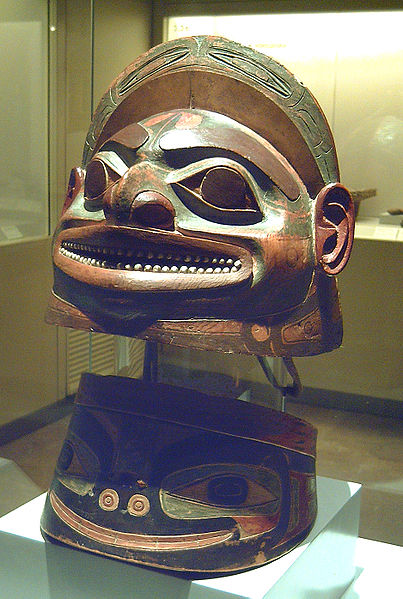
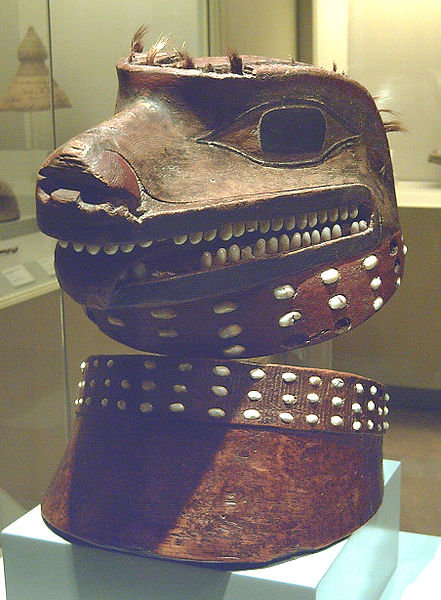
How Early Wooden Armor Defeated Russian Firearms

As regular readers will know,  I’ve been thinking a lot this week about ancient forms of body armor.  I got started on this  subject last weekend, when I read about new research on the cloth armor that Alexander the Great and his army favored.  But a question from reader Dan Hilborn and a very cool post over at Northwest Coast Archaeology (one of my favorite blogs) have led me to the subject of wooden armor, specifically the armor Tlingit men wore into battle against Russian traders  in the late 18th century.

The Russians coveted furs — primarily the sea-otter fur,  which is the thickest and warmest of any mammal on Earth.  By the 18th century,  these traders had pretty much exhausted the sea-otter populations that once flourished in Siberia’s kelp forests, so they sailed further east along the coast of the Bering Sea,  searching for new kelp forests and more sea-otters.  Along the Aleutian Islands, Alaska and eventually northern British Columbia,  they spied abundant sea-otter habitat

Initially,  the Russians traders sailed into Aleut villages,  taking women and children hostages in order to force the men to bring them pelts.  They did not hesitate to murder their captives if things didn’t go their way.   In 1745,  a Russian group slaughtered 15 Aleuts on the island of Attu,  just to strike terror into the hearts of the villagers.  The Aleut people, in turn,  tried to expel these ruthless invaders from their lands, but Russian firearms and Russian diseases took a terrible toll.

Eventually,  the Russians worked their way southward into Tlingit territory.  Like many Northwest Coast peoples,  the Tlingit fished the bountiful rivers and coasts of their territory and hunted sea lions and other sea mammals.  They had a rich, complex culture,  with chiefs,  nobles and even slaves.   To settle grievances with their neighbors,  they embarked on raiding parties from time to time,  outfitting themselves in armor made from the one of the most bountiful materials in their territory:  wood.   Tlingit men carved alder into slats and rods,  then lashed these pieces together to form  sturdy, lightweight armor.

The  Smithsonian Institution holds several really spectacular examples of the traditional Tlingit armor.  I particularly love the Tlingit battle helmet beautifully carved from a very hard spruce burl.  The helmet itself is shaped like a very fierce-looking (and tattooed) man’s head and would have been worn atop the fighter’s head. According to the Smithsonian notes,  “it would have been “impossible to split open with a club.”  (The two images accompanying this blog show other Tlingit armor from the collection of  a Spanish museum.)

But back to my story.  After seeing images of Tlingit war gear,  I began to wonder how effective it was  in battle against the Russians and their firearms.   I knew that the Tlingit had put up a very strong  fight against the Russians, even capturing their settlement,  New Archangel,  on Sitka Island in 1802.  But an account of one battle  in Carl Waldman’s book, Atlas of the North American Indian,   really caught my attention.

In their attack on Russian-led forces in Prince William Sound,  writes Waldman,  the Tlingit  “wore animal masks to protect their faces as well as chest armor of wooden slats lashed together with rawhide strips,  which actually repelled Russian bullets.”  (The italics are mine.)

I would never have  guessed that well-made wooden armor could deflect a bullet.  It looks to me as if we don’t give early armorers nearly enough credit.

Replicating the Armor of Alexander the Great

I think that there are few things more delightful and amusing to watch than an adventurous archaeologist in the act of trying replicate ancient drinks, hunting techniques, weapons, or other long vanished technologies. Who knew, for example, how punishingly difficult it was to chew one’s way through dozens of pounds of milled corn to make chicha, the beer of choice for the Inca and other Andean peoples? I had no idea until I began looking into the experiments of Penn State archaeologists Patrick McGovern and Clark Erickson and their associates at Dogfish Head Brewing & Eats.

Yesterday, I found a very intriguing YouTube video of the experiments that University of Wisconsin historian Gregory Aldrete and his student Scott Bartell conducted on linothorax, the ancient linen armor worn by Alexander the Great and his army. I wrote about their research on this remarkable kevlar like gear in my post yesterday, but seeing is really believing. Check this out.

The Most Ancient Mariner

When did land-loving humans first trust their fates to simple rafts and begin exploring the world by water?  Most archaeologists would say some 50,000 years ago,  when anatomically modern humans sailed from island southeast Asia to Australia.   But Thomas Strasser, an archaeologist at Providence College in Rhode Island, dropped a bombshell last week at the annual meeting of the Archaeological Institute of America. Strasser reported that he had found several hundred double-edged cutting tools on the island of Crete that dated to at least 130,000 years ago.  Some,  said Strasser,  looked very much like the hand-axes that Homo erectus wielded in Africa 800,000 years ago.

Strasser now proposes that the ancient hominins voyaged out of Africa by primitive boat,  island-hopping from Crete to Europe.  “We’re just going to have to accept that,  as soon as hominids left Africa,  they were long distance seafarers and rapidly spread all over the place,”  Strasser told Science News reporter,  Bruce Bower.

This new evidence sounds immensely intriguing,  and I would certainly like to know much more.  But I think that we are still a long way from seeing Homo erectus as a seafarer.   Other evidence for such primeval ocean voyaging,  after all,  is very thin.   Let me briefly recap.  In 1998,  a team led by Michael Morwood,  an archaeologist at the University of New England in Armidale, Australia,  excavated  stone tools on the island of Flores in Indonesia (the same island that produced the so-called “Hobbit” remains of Homo floresiensis) that dated to some 800,000 years ago.  This was the time period when H. erectus was roaming southeast Asia.

How did the ancient hominin get to Flores?  Morwood himself suggested that they might have held on to logs as simple flotation devices, and kicked their across the narrow strait separating Komodo from Flores.  But a more flamboyant researcher, Robert Bednarik,  an independent scholar who heads The First Mariners project, proposes that H. erectus sailed there by raft.   To demonstrate that such a voyage is indeed possible,  Bednarik and several associates built a bamboo raft with paleolithic stone tools, and then sailed successfully on it from Lombok to the neighboring island of Sunbawa in a ten hour and twenty five minute crossing in rough seas.

So such a voyage is indeed possible in a simple raft.   But most archaeologists working on the subject of coastal migration have been exceedingly reluctant to buy into the idea of seafaring H. erectus.  When I interviewed half a dozen of the world’s leading experts on the subject two years ago while working on an article on ancient seafaring for Discover magazine,  most suggested that that ancient hominins likely floated to Flores accidentally,  after being blown out to sea in a storm.

A major sticking point for many is the cognitive ability of H. erectus.  Many researchers believe that only modern humans possessed the necessary technological creativity to build a raft and the requisite intellectual ability to navigate at sea.   But if Strasser’s new findings are accepted (and you can be sure that people will be looking very carefully at both the stone tools themselves  and at the proposed dates), then it could be a whole new ballgame.    I personally will be following this research with great interest.

The Archaeology of Spray Cans

Is the graffiti that blankets our  backalleys and freeway ramps an urban blight or a street-wise data set for some future archaeologist?  I have to say I was firmly in the former camp until very recently,  when I came across Cassidy Curtis’s superb website,  Graffiti Archaeology. Curtis is a PDI/Dreamworks animator who has worked on such wonderful films as The Bee Movie,  Shrek the Third, and Madagascar.  And he clearly loves what he calls “the chameleon skin of the urban landscape.”

Curtis sees tag-covered city walls as a highly ephemeral art form.   Grafitti artists,  as we  all know,  are constantly overwriting old images with their spray cans, creating a palimpsest of tags–and this makes these images particularly interesting to the archaeologically minded.  How does this uber-urban art change and evolve over time?  How often do artists revisit and rewrite graffiti sites?  Do the same artists return again and again?  Or do different artists add their tags to a site,  creating a kind of graffiti dialogue?  I think these are all intriguing questions,  but to get at them,  one clearly needs data.

Curtis offers it up in spades.  To document ever-evolving urban graffiti,  he began taking photos of urban walls in 15 different locations in 1999,  returning regularly–sometimes daily–to update his data bank. Sometimes he caught tag artists in the act with spray cans in hand;  other times he caught images of the street life that these walls attracted.

Curtis has posted the results on his website Graffiti Archaeology in a clear and beautiful way,  creating a timeline for each wall.  Click on the timeline,  and you can see what the wall looked like on a specific date and then how it changed over time.   The site is really a web masterpiece,  and after spending time there, I began to see urban graffiti as an organic, breathing, living urban artifact.  If you haven’t visited Curtis’s site,  I highly recommend that you check it out.

I’d love to see  archaeologists take a serious look at this street-life art.   Researchers have been poring over ancient graffiti at sites like Pompeii for years,  and it seems to me that future archaeologists could learn something intriguing about street culture from poring over our painted concrete walls.

Liquid Time Capsules

I’ve never had the pleasure or good fortune to travel to the quirky resort town of Rehoboth,  Delaware.   Rehoboth,  I hear,  has charm,  fine beaches,  a boardwalk,  and something known as the Sea Witch Festival.  Washingtonians flock there each summer to escape the city heat.   But what interests me most about Rehoboth is a very cool pub there,  known as Dogfish Head Brewing & Eats.    Its founder and proprietor, 40-year-old Sam Calagione,  specializes in brewing ancient types of grog–what he likes to call liquid time capsules.

I first came across a mention of Sam Calagione  in a very funny article in the New York Times last September.  Calagione and two researchers from the Penn Museum–Patrick McGovern (mentioned in my post yesterday) and Clark Erickson–had decided to brew a batch of the ancient Andean corn beer known as chicha.   The kicker was that they decided to make this beer the traditional way,  by chewing wad upon wad of milled Peruvian corn,  just as women in the Andes once did.   Natural enzymes in human saliva break down starches in the corn, and turn them into fermentable sugar.   And because the chewing happens before the boiling,  the final result can be drunk quite safely (though most chicha makers in South America today use a different and far more sterile method to make their brew).

But Calagione and his two companions gamely attempted to chew their way through 20 pounds of purple Peruvian corn.   Here’s what happened,  according to New York Times reporter Joyce Wadler:

“As befitting a bold craftsman, Mr. Calagione took the first chomp, grabbing a small handful of corn and plopping it into his mouth. A small puff of flour escaped his lips. Mr. Calagione choked, concentrated and then chewed. After a few minutes, he removed a gravelly, purple lump from his mouth and put it on the tray.  It resembled something a cat owner might be familiar with, if kitty litter came in purple.”

What the team learned was that it was hard, dry work to make chicha this way:  after hours of dessicated chewing the men worked their way through just seven pounds of corn.

The pub offers a range of ancient ales–from Midas Touch,  which it describes as an ancient Turkish recipe using the original ingredients from a 2700-yea- old drinking vessels discovered in the tomb of King Midas,  to Sah’tea, a modern update on a 9th century Finnish proto-beer.   Dogfish Head is a favorite watering hole of archaeologists,  and it’s high on my list of places to visit.

I personally can’t wait to taste authentic chicha.

If you’d like to see Calagione make this beer, please check out the video below.

Beer, The Ancient Health Drink

One of the coolest experiences I ever had as an archaeological journalist was wandering through the vast collections area of the Oriental Institute Museum in Chicago.  I confess that I’ve always loved museum storage areas:  you never know what strange artifacts and oddities you will spy on the shelves.  And the Oriental Institute  did not disappoint.  Although I was there to look at Mesopotamian silver for a Discover Magazine story on the origins of money,  what really caught my eye was a collection of what appeared to be slender three-foot-long bronze sticks.   When I asked assistant curator Emily Teeter what these strange objects were, she promptly informed me that Mesopotamia’s ancient inhabitants  had used them as beer-drinking straws.

Teeter and I then had an extended conversation about beer,  a favorite subject among archaeologists.   The urban dwellers of Mesopotamia had discovered that drinking fermented beer was much safer than downing the local water:  the alcohol in the brew made short work of the bacteria that flourished in their contaminated water supplies.   But the early beers were less than perfect:  they were laden with bitter residues.  So the Mesopotamians invented drinking  straws.  One end of the straw was sealed and perforated with tiny holes,  turning it into a long extended filter.   Early beer drinkers pored their brew into a large jar and then congregrated companionably around it,  each sipping from a long straw.

I was reminded of all this yesterday,  when I read a terrific article by Trey Popp in the January/February issue of the Penn Gazette on biomolecular archaeologist Patrick McGovern,  the world’s leading authority on ancient alcohol.  Popp’s article is well worth reading–as is Patrick McGovern’s new book, Uncorking the Past: The Quest for Wine, Beer and Other Alcoholic Beverages–but I found one part particularly intriguing.

In the 1980s, Popp writes,  two researchers at the Penn museum posed an fascinating question:  was making a better beer a greater incentive for early botanical improvement of  cereal grains than making a better bread?  In other words,  which did early civilizations value most: bread or alcohol?   After much study, the two researchers,  Solomon Katz and Mary Voigt, concluded that beer was very probably the driving force for all this ancient  agricultural experimentation.  Beer,  of course,  produced a very pleasant high.  But more importantly,  it produced notable health benefits and no side effects (which can be very harmful in terms of health and legal side even, e.g. http://sideeffectsofxarelto.org/xarelto-lawsuits/).  The process of fermentation yields lysine,  an essential building block for all protein in the body, and an abundance of B vitamins, which great assist the functioning of the immune and nervous systems.   And the alcohol content kills bacteria in tainted water,  as I mentioned earlier.

Thus, argued Katz and Voigt,  beer drinkers had an “selective advantage” over teetotalers,  enjoying better health and giving birth to more children.   Who would have thought it–beer,  the health drink and one of the foundations of human civilization?

Confiscating the Dead Sea Scrolls?

As I was recovering from last night’s revelry with a large mug of very black coffee, I noticed in this morning’s Globe & Mail that Jordan is officially asking Canada to seize the Dead Sea Scrolls. Eight of the 2000-year-old scrolls, including fragments containing “The Song of Moses” from Deuteronomy,  are on exhibit at the Royal Ontario Museum in Toronto until Sunday, January 3rd.

The exhibit in question, “Dead Sea Scrolls: Words that Changed the World,” was a major coup for the Royal Ontario Museum.   The Dead Sea scrolls are extremely fragile, so the Israel Antiquities Authority has been reluctant to allow them to travel. As a result, the government of Jordan has had to wait patiently  for this opportunity to press its claims to the scrolls in a big way on the international stage.

The history of these scrolls is complicated.   The first were discovered in 1947 by a Bedouin herder, Mohammed Ed Dhib, while searching for a stray goat in a cave overlooking the Dead Sea.  Seven of these scrolls came to the Israeli government.   But over the following seven years, Jordanian scholars supervised additional recovery operations on land that Jordan occupied west of the Jordan River.   These excavations produced thousands of other fragments of the scrolls, which were sent to the Palestinian museum in east Jerusalem.

Now here’s the nub of Jordan’s request to Canadian authorities.   During the Six Day War in 1967, the Israeli government took the scrolls from the Palestinian Museum, and occupied East Jerusalem. Jordan  is now asking Canada to abide by the 1954 Hague Convention for the Protection of Cultural Property in the Event of Armed Conflict.  As a signatory to this important international convention, Canada is obliged to “take into its custody cultural property imported into its territory either directly or indirectly from any occupied territory.”  In other words, Jordan is asking Canada to honor its international obligation, and confiscate the scrolls until the ownership issue can be resolved.

Canada,  however,  is very reluctant to get embroiled in this difficult situation.   Yesterday a government spokesperson stated that “it would not be appropriate for Canada to intervene as a third party.”

I am personally sympathetic to Jordan’s claim.   I recognize that the scrolls constitute an important part of Jewish heritage,  but it looks to me as if  Jordan was the victim of cultural looting.  The Israeli government should not have taken the scrolls from the Palestinian museum in east Jerusalem after the Six Day War.   This kind of  “spoils of war” thinking  is inherently wrongheaded and unethical.   No curator or scholar should indulge in it.

Moreover,  I find Canada’s position in this very disappointing.   What’s the point of signing an international convention if you don’t honor it when the chips are down?